More women – and their husbands – in work due to rising female pension age

By Nuffield Foundation

Since April 2010 the age at which women can first receive a state pension has been rising from 60. It is currently at 61 years and 5 months and is due to rise to 66 by 2020.

So far this change, first legislated in 1995, has had a strong effect in increasing employment among those women directly affected by the reform. It has also changed the behaviour of some of the husbands of the affected women – possibly because they are delaying their own retirement so they both retire together or perhaps to cover their wives’ lost pension income with additional earnings.

These are among the main findings of new research launched today by researchers at the Institute for Fiscal Studies. This report has been supported by the Nuffield Foundation and the IFS Retirement Saving Consortium.

The research uses data from the first two years since the female state pension age began to rise from age 60 in April 2010 to examine its impact on labour market outcomes. The findings show that, as a result of the one year increase in the female state pension age – from age 60 to 61 – that occurred between April 2010 and April 2012:

  • Employment rates among 60 year old women have increased by 7.3 percentage points: in other words, in April 2012 there were 27,000 more women in work than there would otherwise have been
  • Employment rates among their husbands have increased by 4.2 percentage points: in other words, there were 8,300 more men in work than there would otherwise have been
  • 1.3 percentage points more women aged 60 were unemployed: in other words, there were 5,000 more women aged 60 not in work but looking for work than there would otherwise be
  • The UK’s public finances have been strengthened by around £2.1 billion.

It is difficult to extrapolate these results to infer the effects of the further planned increase in pension ages for men and women. However, our results suggest future increases in the state pension age will lead to a substantial increase in employment and will strengthen the public finances.

The effects we found are especially large given that most women (and men) do not retire at their state pension age. The employment rate for 60 year old women rose from 41.5% to 51.4% between 2010Q1 and 2012Q2. These effects have also been seen in the context of a weak economy which might have made staying in, or finding, work more difficult.

What is causing this change? Increasing the state pension age does affect the financial return to remaining in paid work. However the size of the effect we find suggests that things other than these pure financial incentives are at work. In the first place women may be using the state pension age as an “anchor” in making their retirement decisions. The change in pension age could change social norms. In addition there is evidence that some women did not realise in time that their state pension age was no longer 60 and so did not take action, for example to increase saving, to offset the effect.

Jonathan Cribb, a research economist at the Institute for Fiscal Studies and a co-author of the report, said, “Increasing the age at which women can first receive their state pension has led to significant numbers of women deferring their retirement, with over half of women aged 60 now in paid work for the first time ever. We also find that some husbands are responding by remaining in work for longer. Taken together, there were 35,000 more men and women in work as a direct result of the increase in the female state pension age – from age 60 to 61 – that occurred between April 2010 and April 2012. So, despite the weak performance of the UK economy over these two years, many have been able to limit the loss of state pension income through increased earnings. These results apply only to the first groups affected and how women and men respond may change as the pension age rises further. But this is initial evidence that raising pension ages can have significant positive effects on employment.”
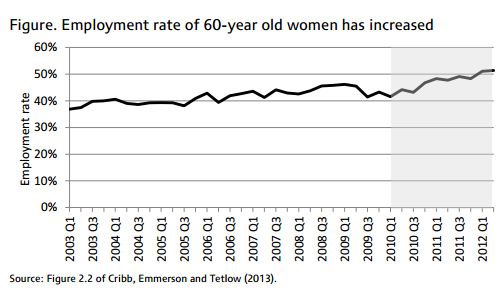
Employment rate of 60-year old women has increased

Notes

1.“Incentives, shocks or signals: labour supply effects of increasing the female State Pension Age in the UK” by Jonathan Cribb, Carl Emmerson and Gemma Tetlow, will be presented at 10am on Friday 8th March 2013 at the Nuffield Foundation.

2. This research is funded by the Nuffield Foundation and the IFS Retirement Saving consortium which comprises Age UK, Association of British Insurers, Department for Work and Pensions, Financial Services Authority, HM Treasury, Investment Management Association, Money Advice Service, National Association of Pension Funds, Partnership Pensions and the Pensions Corporation. Co-funding from the ESRC funded Centre for the Microeconomic Analysis of Public Policy at IFS (grant number RES-544-28-5001) is also gratefully acknowledged.

3. The Nuffield Foundation is an endowed charitable trust that aims to improve social well-being in the widest sense. It funds research and innovation in education and social policy and also works to build capacity in education, science and social science research. The Nuffield Foundation has funded this project, but the views expressed are those of the authors and not necessarily those of the Foundation.

Explore our projects

A portrait of a teenager wearing casual clothing on an overcast summer day in Whitley Bay, Northeastern England. They are standing and looking concerned as they use their smartphone.
In progress

Welfare | 2026 - 2028

The digital lives of care-experienced children

View project
A simple wall sign outside the British Treasury building at 1 Horse Guards Road, just off Whitehall, London.
In progress

Welfare | 2026 - 2030

IFS Green Budget 2026 – 2029

View project
Young well dressed businesswoman working on a computer at the office

Welfare | 2026 - 2029

Pain-at-Work Toolkit for employees with chronic pain (definitive trial) 

View project
Young woman using a digital printing machine on an apprenticeship
In progress

Education | 2026 - 2027

Apprenticeship Pathways

View project

Welfare | 2026 - 2028

Examining gender pension gaps: trajectories over time in the UK

View project
Parents with baby
In progress

Education | 2026 - 2028

Your Baby and You: Developing the home learning environment for babies

View project
A cheerful young man wearing a green apron and a grey hoodie. He is placing fresh baked goods outside a cafe, holding a bowl filled with freshly baked bread. The cafe is in the background.
In progress

Education | 2026 - 2027

Student employment and subsequent education and labour market outcomes 

View project
Houses along a street in the UK

Welfare | 2026 - 2028

Towards housing affordability: local supply drivers and optimal policy

View project
In progress

Racial Diversity UK | Welfare | 2026 - 2027

Racial equality since devolution: Divergences, outcomes and frontiers

View project
voters entering polling station to vote in election

Welfare | 2025 - 2026

Tax, benefits and public spending in the 2026 devolved elections

View project

Welfare | 2025 - 2026

2026 Scottish Parliament and Senedd election analysis

View project
A shot of a grandfather sitting in a tractor with his young granddaughter, he is at his farm in North East, England. The grandfather and the girl's mother are teaching her about the farm.
In progress

Welfare | 2025 - 2028

Arthritis and farmers in England: Impacts, adaptations and prevention

View project
A simple wall sign outside the British Treasury building at 1 Horse Guards Road, just off Whitehall, London.
In progress

Welfare | 2026 - 2030

IFS Green Budget 2026 – 2029

View project
A portrait of a teenager wearing casual clothing on an overcast summer day in Whitley Bay, Northeastern England. They are standing and looking concerned as they use their smartphone.
In progress

Welfare | 2026 - 2028

The digital lives of care-experienced children

View project
Young well dressed businesswoman working on a computer at the office

Welfare | 2026 - 2029

Pain-at-Work Toolkit for employees with chronic pain (definitive trial) 

View project
Young woman using a digital printing machine on an apprenticeship
In progress

Education | 2026 - 2027

Apprenticeship Pathways

View project
Parents with baby
In progress

Education | 2026 - 2028

Your Baby and You: Developing the home learning environment for babies

View project

Welfare | 2025 - 2026

2026 Scottish Parliament and Senedd election analysis

View project
Houses along a street in the UK

Welfare | 2026 - 2028

Towards housing affordability: local supply drivers and optimal policy

View project

Welfare | 2026 - 2028

Examining gender pension gaps: trajectories over time in the UK

View project
voters entering polling station to vote in election

Welfare | 2025 - 2026

Tax, benefits and public spending in the 2026 devolved elections

View project

Welfare | 2025 - 2028

Actionable insights to tackle UK dietary inequalities

View project
A mid-level street view of an older brick social housing block. To the left is a large green tree.

Welfare | 2025 - 2026

Navigating social housing tenancies: Language and cultural barriers

View project
A cheerful young man wearing a green apron and a grey hoodie. He is placing fresh baked goods outside a cafe, holding a bowl filled with freshly baked bread. The cafe is in the background.
In progress

Education | 2026 - 2027

Student employment and subsequent education and labour market outcomes 

View project
A simple wall sign outside the British Treasury building at 1 Horse Guards Road, just off Whitehall, London.
In progress

Welfare | 2026 - 2030

IFS Green Budget 2026 – 2029

View project
A portrait of a teenager wearing casual clothing on an overcast summer day in Whitley Bay, Northeastern England. They are standing and looking concerned as they use their smartphone.
In progress

Welfare | 2026 - 2028

The digital lives of care-experienced children

View project
Young woman using a digital printing machine on an apprenticeship
In progress

Education | 2026 - 2027

Apprenticeship Pathways

View project
Parents with baby
In progress

Education | 2026 - 2028

Your Baby and You: Developing the home learning environment for babies

View project
A cheerful young man wearing a green apron and a grey hoodie. He is placing fresh baked goods outside a cafe, holding a bowl filled with freshly baked bread. The cafe is in the background.
In progress

Education | 2026 - 2027

Student employment and subsequent education and labour market outcomes 

View project
In progress

Education | 2025 - 2027

Racial inequalities in access to professional careers – what matters?

View project
In progress

Racial Diversity UK | Welfare | 2026 - 2027

Racial equality since devolution: Divergences, outcomes and frontiers

View project
In progress

Racial Diversity UK | Welfare | 2025 - 2028

Decline to renewal: Race, deindustrialisation and working lives

View project
In progress

Racial Diversity UK | Welfare | 2025 - 2028

Better mixing: Supporting Scotland’s diverse future

View project
In progress

Racial Diversity UK | Welfare | 2025 - 2028

Voices for equity: Moving from evidence to action

View project
Two mothers cuddle their daughter on the sofa with their dog: Welfare access, assets and debts of LGBT+ people in the UK
In progress

Welfare | 2025 - 2027

Understanding fertility intentions in 21st century Britain

View project
In progress

Welfare | 2025 - 2027

Musculoskeletal conditions, employment retention and job quality

View project
Black woman typing on laptop in living room
Reported

Welfare | 2024 - 2025

Enhancing, localising and democratising tax-benefit policy analysis

View project
A middle-aged man sat at home is looking at this phone while sorting pension paperwork.
Reported

Welfare | 2023 - 2025

Collective defined contribution pensions with investment choice

View project
Two little boys and a little girl, all wearing primary school uniform, work together to solve a puzzle in their classroom.
Reported

Education | 2023 - 2025

What has ‘Free School Meals’ measured and what are the implications?

View project
Elderly man drinking tea at home with professional carer
Reported

Welfare | 2023 - 2024

Evidencing the outsourcing of social care provision in England

View project
Older woman using a tablet to make a video call
Reported

Welfare | 2023 - 2025

Remote osteoarthritis peer-mentorship for socioeconomically underserved people

View project
Male and female apprentices looking at car engine
Reported

Education | 2022 - 2025

Work or study? Gender and the transition from school to work

View project
Older man working from home on a video call
Reported

Welfare | 2022 - 2024

The impact of pension auto-enrolment and COVID-19 on saving behaviours

View project
A man working as a delivery driver sits in the driver's seat, checking his list on a tablet
Reported

Welfare | 2022 - 2023

Redesigning labour market policies for the future of work

View project
A group of women walk in a park with their children in pushchairs
Reported

Welfare | 2022 - 2024

Nature-based integration: connecting communities with/in nature

View project
Reported

Education | Welfare | 2022 - 2024

Understanding school attendance, education and labour market outcomes

View project
Two women talk outside a cafe
Reported

Welfare | 2022 - 2023

Housing 21: exploring a more inclusive model of cohousing

View project
A woman helping a little girl get ready for school
Reported

Justice | Welfare | 2022 - 2024

Race, religion and representation among care-experienced children

View project
Search projects

We improve people’s lives by funding research that informs social policy, primarily in Education, Welfare and Justice. We also fund student programmes that give young people skills and confidence in science and research.

We offer our grant-holders the freedom to frame questions and enable new thinking. Our research must stand up to rigorous academic scrutiny, but we understand that to be successful in effecting change, it also needs to be relevant to people’s experience.

Profile