Your feedback is valued
If you have a few minutes, please provide your thoughts on the 'Guide for applicants' to help shape this page.Section 1: What we fund
This Guide for applicants sets out our research funding application process and how to apply.
Section 1 outlines our areas of research interest for Main Grants funding opportunities. Sections 2-4 apply to the majority of our funding opportunities unless otherwise stated. Section 2 describes what we expect from the projects we fund and what we offer in return. Section 3 sets out our eligibility criteria, and Section 4 onwards provides guidance on the application process.
With up to £10 million available each year through our Main Grants Fund, we invite applications for research and innovation that have the potential to improve people’s lives. We are particularly interested in work that brings insight, rigour, sound evidence and nuance to bear on one or more of the five priority questions identified in our 2025 Strategic Review.
1.1 Our priority questions
1.2 Areas of continued focus
Section 2: About our grants
2.1 What we expect from research that we fund
Relevance
All applications must be relevant to one or more of our five priority questions. Applicants need to make a clear case for the importance of their proposed project and how it would add to the existing knowledge base.
Applications should be directly concerned with UK issues and society. This includes work that draws on the diverse realities of place across the UK – whether at the national, regional or city level – as well as work using international comparisons to set UK policy and practice in a wider context and to illuminate promising alternative approaches.
If, after reading this Guide, prospective applicants remain unsure about their project’s alignment with our areas of interest they can send a one-page summary of their proposal to applications@nuffieldfoundation.org and we will comment on potential topic fit.
Impact
Applications must demonstrate a clear path to how the research and related activities might improve people’s lives in the UK.
We recognise that there are multiple routes to achieving impact and that advancements can come about because of the accumulation of evidence over time. Applications should be as specific as possible about what the project’s potential routes to impact may be, even if the path is not certain. We consider five dimensions in which our work can have impact, although we do not expect applicants to aim for, or achieve, every dimension:
- Informing change to policies, systems or legislation
- Informing practice change
- Advancing understanding or awareness of an issue
- Changing attitudes or perceptions
- Providing opportunity and building capability
Credible communications and engagement plans should identify the main audiences for the research, routes to reach them, and how the outputs and dissemination approach proposed advance the impact aims identified. These plans should include adequate resource for impact activities, and for project management.
Rigorous and appropriate method
While they may take many different forms, proposals to us must be impartial, objective and rigorous. Applicants should be open-minded to the outcomes of any research and committed to basing any conclusions or recommendations on what the evidence shows.
We are open to all social science and related methodologies. Our key test is that the method is credible, rigorous and appropriate for the question being addressed. We also look for a clearly articulated analytical framework that demonstrates understanding of the social context in which the research will be conducted. We welcome a wide range of methodologies and approaches, including:
- Insights from existing research – This includes research reviews, synthesis, translation and critical evaluations of existing evidence, including meta-analyses and narrative reviews, to inform policy and practice or generate new research agendas. Translation activity might explore how different approaches can help practitioners better use existing or new data to improve outcomes or service provision.
- Data collection and analysis – We welcome both quantitative and qualitative data collection and analysis, including participatory research. Primary data collection is only funded when it is an integral part of a wider project. We do not fund large-scale data infrastructure projects.
- Intervention development and early evaluation – The Foundation has a long track record of funding the development of evidence-based interventions and we currently support a variety in the field of education. We would also like to encourage more proposals in our other areas of interest (beyond education) that test new ideas and bring research and evaluation closer to real-world practice. Further detail of our expectations for intervention development and early evaluation is available in ‘Additional information: Intervention development and early evaluation funding’.
We are keen to support cross-disciplinary research, as well as experimental and innovative approaches. We are also looking for active engagement with the complexity of people’s lives and are interested in funding more research that takes an intersectional approach to understanding and highlighting the inequalities, disadvantages, discrimination and vulnerabilities that people face, how they intersect and what should be done about them.
We also fund:
- New institutional capability – We support new or emerging institutions where we wish to build stronger capacity to address a strategic issue that aligns with our purpose. We are open to providing funding to new or existing organisations, not necessarily academic institutions, looking to fill a significant evidence need or gap in one of our focus areas, and then deploy that insight to innovate and improve policy, practice and public understanding.
- Other projects – This includes small-scale inquiries, working parties or similar to reach common ground on a priority policy or practice issue, and to research or identify a potentially workable way forward. We also welcome exploratory analysis of new data to inform the feasibility and potential for further analysis.
Expertise, experience and potential
Applications should demonstrate that the team possess the appropriate experience, expertise and potential to carry out the project as planned. We are not only interested in academic expertise: we are also looking for strong project management and impact/influencing skills in the teams that apply to us.
In addition to funding research that tackles society’s most pressing challenges, we are committed to investing in the next generation of researchers. We expect our grant-holders to actively support early career researchers to develop in their careers, and applicants should explain how the capability of early career researchers will be enhanced through their project.
Through our Emerging Researchers Network, we offer some networking support and training to early career researchers involved in our projects.
Value for money
We are a charity and are keen to ensure we achieve value for money in the grants that we fund. Value for money considerations include whether the cost of the project is justified by the potential benefits and is in line with comparable research, as well as whether resources are being used in the best way to achieve the intended outcomes.
2.2 What we offer
Our expert grants teams work closely with grant-holders, collaborating throughout the project to help maximise the impact of each grant, including by providing templates for developing communication plans and stakeholder maps, and making connections with other Nuffield projects, programmes and activities.
This includes bringing together the research that we fund with the work we directly undertake through our expert centres (the Nuffield Council on Bioethics, the Nuffield Family Justice Observatory and the Ada Lovelace Institute) and our own strategic research projects, currently ‘Grown up? Journeys to Adulthood‘ and ‘Public right to justice‘. We are interested in applications that also consider these connections and align with themes emerging from them. More information about these programmes is available on our website, and we will update guidance with more-specific funding priorities as these areas of work progress.
Grant size and duration
- We accept applications up to £500,000.
- Most of the grants we award are below £300,000.
- Occasionally applications for up to £750,000 are accepted for consideration but only if there is a strong case and clear value for money. We recommend sending an enquiry to applications@nuffieldfoundation.org at the start of the application process if you would like to submit an application for over £500,000.
- Smaller grants (under £15,000) are also available, and these may be fast-tracked if there is a case for an accelerated decision.
- Funded projects usually last between six months and three years, but projects with shorter or longer timelines are occasionally funded.
Other funding opportunities
Our Strategic Fund is for ambitious cross-cutting projects – typically in the range of £1m-£3m. We are looking for new, transformative ideas that are capable of anticipating and addressing the most significant themes and developments shaping the UK public policy agenda. Please refer to the Strategic Fund: Guide for applicants. The next Strategic Fund round is likely to be opened in the first half of 2027, and we will share the date on our Funding for research page, as well as in our newsletter and social media.
The Racial Diversity UK programme aims to better understand the potentials and challenges for the UK’s racially diverse future. The programme enables work taking a fresh look at how changing patterns of racial diversity and disparity, particularly as shaped by the UK’s colonial past, develop and shape society – now and in the coming decades. The programme page includes information about the specific priority areas for each funding round. The next application deadline is 5 October 2026.
The Oliver Bird Fund supports initiatives that improve the social and economic well-being of people living with musculoskeletal conditions. We are exploring broadening the fund’s focus to also include other disabilities and health conditions, including mental health, that are increasing in prevalence and significantly affecting people’s lives. In line with our overall focus on shared prosperity, our aim is to boost employment, tackle poverty, and widen access to support. The next application deadline is to be confirmed. Details of priority areas and the application deadline will be shared on the Oliver Bird Fund webpage.
2.3 Overview of the application process
Application process:
- There are two stages:
- Outline application – to test the idea and proposed approach.
- Full application – invited if the outline is successful.
- On average, 1 in 10 Outline applicants are invited to submit a Full application.
- Success rates for Full applications vary from round to round, but generally around half of Full applications secure funding. Decisions are based on rigour, relevance and potential for impact, value for money, and availability of funding.
Timing and assessment:
- Applications can currently be submitted at any time through our website.
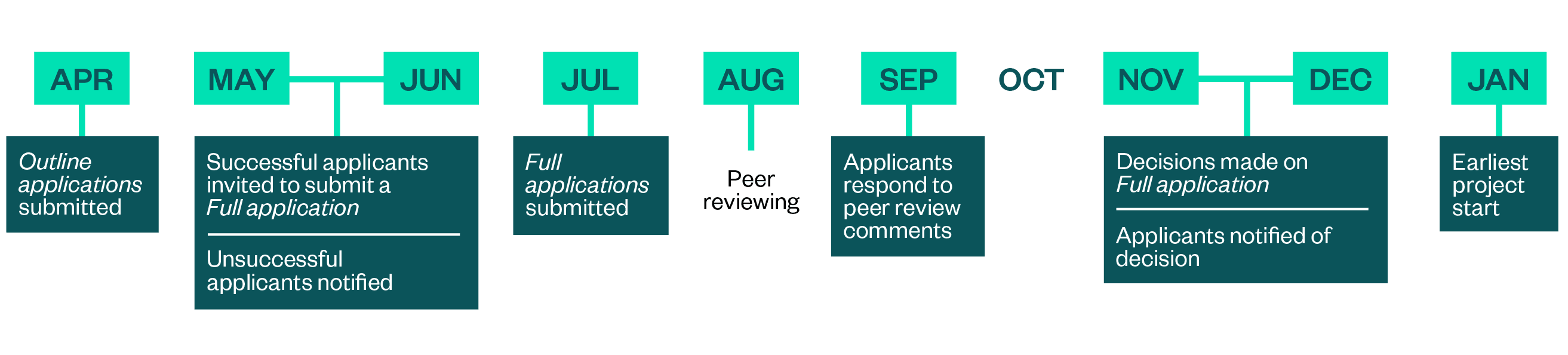
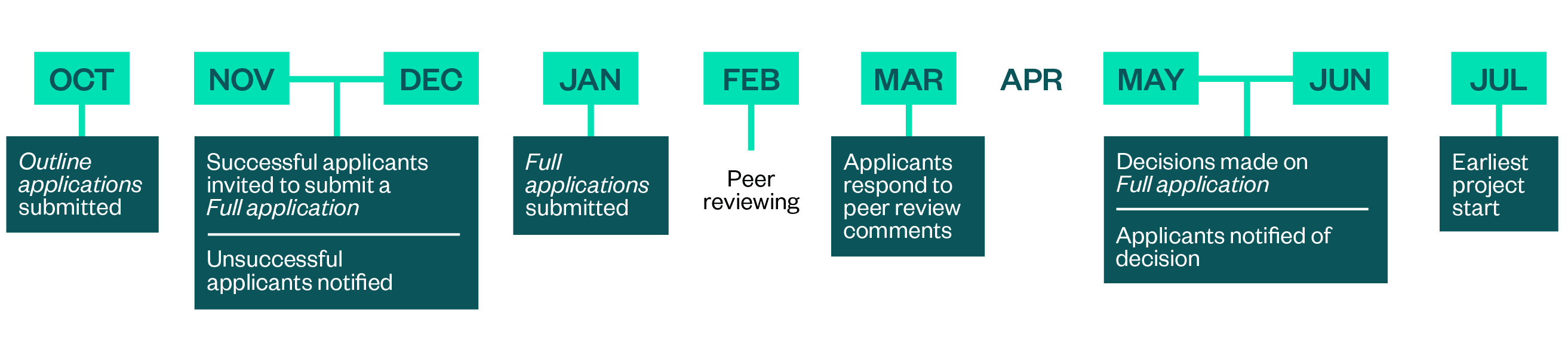
- Shortlisting happens twice a year – spring and autumn. Please keep an eye on our website for deadline dates.
- Shortlisting decisions are made around two months after the outline deadline.
- Final decisions are made in:
- November for spring applications.
- May for autumn applications.
Review and Grant award:
- If a Full application passes initial internal assessment, it goes to external peer review.
- After final assessment, a grant may be awarded – sometimes with conditions.
- Projects should start at least two months after the decision month (May or November).
More detail is provided in Sections 3 to 7 of this Guide.
Section 3: Eligibility
The best way to check eligibility for funding is to use our Eligibility Tool.
3.1 UK context
We welcome applications from UK-based organisations.
Proposals for projects should be directly concerned with UK issues and society – this includes comparative work between the four nations, and international work which results in lessons for UK policy and practice.
3.2 Staffing
Principal Investigators
- Proposed projects must be led by a named Principal Investigator (PI), who is the lead applicant.
- The PI must have a formal employment or contractual relationship with the host institution.
- The PI is responsible for the application and serves as the main contact throughout the process and any subsequent grant period.
- If there are Co-Principal Investigators, one must be designated as the lead applicant and our primary contact for the purposes of grant administration if an award is made.
- We award grants to organisations (the ‘host institution’) not individuals. The PI must be based at the host institution.
Other staff
- Individuals who will have a significant role in assisting the PI in the management and leadership of the project should be named as Co-Investigators (Co-Is).
- Individuals with non-leadership roles on the project should also be named in the application if known, and details provided of any roles into which someone would need to be recruited if an award were made.
Other funders
- Applicants must state in their Outline application if they are applying or have applied for funds elsewhere for the same or a closely related project.
- If the proposal was unsuccessful elsewhere, they should include all feedback received.
- We may contact the other funding organisation(s) for information.
We don’t support general appeals for pooled funding (funders combining funds into single pot with shared decision-making), but we may consider partnership funding (multiple funders supporting a project in parallel).
- Applicants should provide the name of the proposed co-funder(s) and explain the case for co-funding.
- We usually contact the proposed co-funder(s) to discuss the feasibility of co-funding before making a funding decision.
3.3 Multiple proposals
Multiple Outline applications from the same Principal Investigator are allowed, but it is unlikely more than one will be shortlisted in the same funding round.
3.4 Ineligible categories
- Individuals without formal employment or contractual relationship with the institution hosting the grant for at least the duration of the project.
- Projects led by individuals unaffiliated to any particular organisation.
- Projects led by schools or further education colleges.
- Projects led by undergraduates or master’s students.
- PhD fees or projects where the main purpose is to support a PhD.
- The establishment of academic posts.
- Ongoing costs or the costs of ‘rolling out’ existing work or services (unless explicitly agreed with the Foundation in advance of an application being submitted).
- ‘Dissemination-only’ projects, including campaigning work, which are not connected to our funded work.
- Local charities, replacement for statutory funding, or local social services or social welfare provision.
- Requests for financial help or educational fees from or on behalf of individuals.
- Projects led by organisations or institutions that are not based in the UK.
- In exceptional cases, we may accept applications from overseas organisations if no UK-based host is feasible. Applicants must show strong plans for UK-focused dissemination, engagement and impact.
Section 4: Understanding the application process
4.1 Outline applications
Outline applications must be submitted using our online form. Should you need help please contact us at applications@nuffieldfoundation.org.
All applications should address at least one of our Priority Questions. To help with internal routing, please choose the area that best matches your proposal. If in doubt, select ‘Welfare, Work and Economy’. Don’t worry if the fit is not exact, as we will make sure your application reaches the right assessor.
Outline application requirements
Outline applications must:
- Provide a clear, concise and compelling account of the proposal, why it is needed and the impact it is expected to achieve.
- Show the project fits within the Foundation’s interests and that the proposed approach is well considered, fit for purpose and appropriately resourced with a considered budget (staff and costs, including non-academic staff – for example, project managers and communications and engagement expertise).
- Stand alone to make a case, without any need for the reviewers to undertake further research or to follow up the bibliographic references in order to judge the application.
Feedback on Outline applications
- Only a small proportion of Outline applications are shortlisted to proceed to a Full application. We provide constructive advice and support to those shortlisted.
- Due to the high volume of applications we receive we regret that we are not able to provide specific feedback on unsuccessful Outline applications as standard.
- We do not accept resubmissions of unsuccessful Outline applications.
4.2 Shortlisted applications
- Our invitation will include feedback from the Foundation, which must be addressed in the Full application. A submission deadline will also be provided, usually around six weeks from the date of invitation.
- We may request a discussion with shortlisted applicants, and applicants can also request one in order to clarify any feedback.
- Deferrals are rarely granted. If a Full application is not submitted by the deadline (and no alternative timeline has been agreed), the application will be considered withdrawn.
We aim to notify all applicants of our decision by the month shown in the timeline on our website. If you haven’t heard by the end of that month, please contact us applications@nuffieldfoundation.org. Be sure to include the PI’s name and the application reference number.
4.3 Full applications
The invitation to Full application includes a link to the online form for submissions.
The Full application should:
- Be accessible to readers with and without specialist knowledge.
- Demonstrate the team’s knowledge and grasp of the subject and why it is important, as well as the appropriateness of the chosen methods, approach and activities.
- Be standalone and comprehensive, fully demonstrating why the project is important and that the approach will deliver a high-quality and impactful project.
- Build on the Outline application, providing fuller information, including a more detailed budget, and taking into account the feedback received from the Foundation.
- It is particularly important that the Full application expands on the intended outcomes, and the activities applicants will undertake to deliver these.
4.4 Diversity and inclusion monitoring
As part of our commitment to Equity, Diversity and Inclusion, the Foundation collects voluntary diversity data from applicants (PIs and Co-Is) after Outline applications are submitted. This is done via a secure, separate online form, sent by email. Responses are securely and separately stored from other application information, and do not influence application decisions.
If a grant is awarded, further data may be collected from the full project team. All data is anonymised, used for reporting, and deleted after 18 months.
The data we collect enables us to identify and benchmark key trends, evaluate the effectiveness of the actions taken under our EDI Action Plan, and generate insights that inform the development of future priorities.
Section 5: Completing the Outline and Full application forms
5.1 Filling out the form
Alongside contact details and basic information such as the project start and end dates, applicants will need to confirm their project title. Project titles should be clear, descriptive and unambiguous. The sections of the Outline and Full application forms are set out below.
| Outline application form | Full application form |
|---|---|
| Alternative funding sources | Project summary |
| Research questions | Alternative funding sources |
| Case for importance | Research questions |
| Outcomes and influence | Case for importance |
| Methods, approach and activities | Outcomes and influence |
| Research and engagement team | Methods, approach and activities |
| Budget | Research and engagement team |
| References | Expert advice and stakeholder engagement |
| Additional information | Quality assurance and risk management |
| Legal and ethical aspects | |
| Archiving | |
| Timetable | |
| Budget | |
| References | |
| Additional information | |
| Acceptance of Terms and conditions |
For shortlisted applications, aspects of the proposal – including the budget – may be refined between Outline and Full application stage. Some changes may be prompted by the feedback we provide.
5.2 Specific section guidance
Outcomes and influence
We want to understand how the proposed project will make a real-world difference, even if that change takes time. Section 2.1, ‘Impact’, details the five dimensions in which the work we fund and do has impact.
In the Full application we expect applicants to fully elaborate on the project’s intended impact and the activities proposed to support it, as well as who will take these forward and how they will be resourced (costs for associated activities should be included in the budget):
- What are the specific ways in which the research is expected to have an impact and improve people’s lives?
- How will key audiences be identified, and what are the plans for influencing and engaging them? How will they use the proposed research?
- Outline key mechanisms, such as conferences, seminars, meetings with senior policymakers, or the production of online communications or publications aimed at wider audiences.
- We view research reports, briefing papers, other publications, seminars and other events as outputs – dissemination plans must explain how such outputs will be used to drive impact (that is, outcomes).
- We welcome the production of academic journal articles, but these are not usually the primary outputs of the projects we fund. All projects should produce at least one report aimed at as broad an audience as possible, which is freely and publicly available.
- We recommend that applicants read the Guide for grant-holders as this sets out in detail our expectations for a Communications plan, should the project be funded.
Applicants should read ‘Additional information: Impact’ in full before completing this section of the Full application.
Methods, approach and activities
The purpose of this section is to enable applicants to set out the work they will undertake to achieve the aims and objectives of their project, and to address the research questions. It must demonstrate that the proposed design is fit for purpose, the project is feasible and that a high-quality project will be delivered.
In the Outline application we need to see:
- An account of whether the approach is designed to be exploratory, provide a robust descriptive account or infer/understand causality (or a combination of these).
- Details of the population of interest and the unit of analysis; a definition of who will be included in the study and an explanation of why; an assessment of whether some important groups will be excluded, the reasons for this and the impact on the study.
- A description and rationale of the proposed research methods. There needs to be sufficient detail of the approach for the reviewer to assess how reliable and robust it is. For example, applicants may need to cover:
- Sampling – information on the proposed sampling method.
- Quantitative analysis – as an assessment of whether the sample sizes are big enough to test the key relationships with sufficient confidence, including subgroup analysis and with issues of bias considered.
- Qualitative work – sampling criteria and quotas, how the sampling strategy will ensure an appropriate range of individuals and experiences are covered, and the approach to analysis.
- Evaluations – how the ‘counterfactual’ will be assessed and what effect sizes will be detectable
- Discussions of the effects on the analysis of key limitations of the data, and the plans in place to recognise and address them.
At Full application stage we expect a much fuller and more detailed account. Please read ‘Additional information: Full application methods, approach and activities guidance’ before completing this section.
Research and engagement team
We need to be confident that staffing for the project is appropriate and that staff have the necessary expertise and time available to conduct the proposed project. The Outline application requires applicants to provide brief details to support an initial assessment of the team. We do not require CVs at the outline stage.
In the Full application:
- Proposed project management arrangements for the grant should be set out, as well as information on how the contributions of staff working on the project will be managed.
- We request short CVs (one page each) that focus on the skills and experience of the individuals relevant to delivering this project, including any project managers and communications professionals.
- We are keen to develop the future pipeline of researchers in our fields of interest. Applications should demonstrate how all staff in the proposed team will be developed, particularly those at earlier career stages. We also encourage multidisciplinary teams that will share and develop their expertise and networks.
Expert advice and key stakeholder engagement (Full application only)
Applicants must provide details of their plans for engaging with experts and key stakeholders to support the delivery of a high-quality and impactful project.
Quality assurance and risk management (Full application only)
Applicants must provide information on their approach to quality assurance and risk management.
- Applicants should include details of how they will assure the quality of project design, analysis and interpretation of the findings, and project outputs.
- Applicants should also identify any limitations and risks to the project, including any measures they propose to manage and mitigate them. Considerations should include data availability, recruitment and resourcing, budget management, the capacity of the host institution to provide support, media controversy or other reputational risks to the host organisation or funder, and timing issues that have the potential to reduce impact.
Legal and ethical aspects (Full application only)
The Full application also requests details to assure us that the legal and ethical aspects of the project, and the processing of personal data, have been fully considered.
- Where projects involve processing of personal data, we would expect applicants to complete a Data Protection Impact Assessment at the outset of the project.
- We expect an appropriate ethical clearance procedure to be in place before the project commences.
Projects that involve direct contact with participants (‘primary research’) are required to pass through independent ethical scrutiny.
- It is the PI’s responsibility to meet this requirement, and the responsibility of the host institution to:
- Ensure appropriate policies and provision for scrutiny are in place.
- Accept responsibility for the ethical conduct of the research.
- We expect larger research institutes and universities to have standard procedures in place for ethical scrutiny.
- Where there are no such procedures, we are willing to consider alternative arrangements – for example an independent advisory committee convened specifically for the purpose, or use of a scrutiny committee from another institution.
- The budget should include any costs associated with ethical or similar scrutiny.
Timetable (Full application only)
At Full application stage we require a detailed timetabled project plan.
This should set out the various work streams across the months of the project and include when applicants would propose to deliver the various requirements of the grant, including:
- Progress reports
- Communications plan
- Main public output
- End of project assessment
In considering the timetable, applicants should take into account the Foundation’s requirement that grant-holders publish a freely available Main public output, which serves as a concise and accessible account of the project, drawing out key findings and recommendations. This report must be published on the host institution’s website and disseminated before the end of grant date, with a further 6-8 weeks built into project timetables to enable continued stakeholder engagement activity following publication.
End of project assessments should take place at grant completion. We will further review the impact of each grant, with grant-holders, after one year and – in light of our determination to take a long view – also three years after completion.
Applicants may also present this information in Gantt chart form for ease, though this will need to be submitted as part of the document uploaded in the ‘Additional information’ section. Please note this document should not exceed three pages.
Budget
We ask for a high-level budget in the Outline application. We need an estimated budget that indicates the split between staff time (separately for different categories of staff), overheads, and other direct costs (for example, non-staff costs for quantitative and qualitative research). This must comply with our ‘Budget guidelines’ (Additional information: Budget guidelines).
At Full application, applicants will be asked to complete a more detailed version of the budget, under the same broad headings requested at Outline stage.
- This must be entered into the Excel template provided in the application form. Applicants should download the template, complete the budget in the template file and then upload the completed budget where required in the application form. Formulas must not be edited.
- Budgets must be completed by calendar year, not project year.
- Justification for requested costs should be included.
- For details of eligible costs and budgetary guidance please refer to ‘Additional information: Budget guidelines’.
Terms and conditions (Full application only)
- Applicants should read our Terms and conditions before submitting their Full application.
- The host institution must accept these Terms and conditions in principle when applicants submit the Full application.
- If the host organisation has queries about the Terms and Conditions before accepting, they should contact applications@nuffieldfoundation.org.
- Please ensure that the designated individual is informed in advance that they have been nominated as a signatory, as the Nuffield Foundation will then use the contact details provided to contact this individual with a link to a form which must be completed.
Section 6: The Full application assessment process
We need to receive the Full application form, budget and institutional signature to begin the assessment of the application.
6.1 Reviewer comments
We will usually share the Full application, including budget, with a range of peer reviewers (from the research, policy and practice communities as appropriate).
If we receive a Full application that does not contain all the information we need, is not of sufficient quality or has not sufficiently addressed earlier feedback in the letter inviting submission of a Full application, we may decide to reject the application without sharing it with peer reviewers.
We seek to avoid conflicts of interest when selecting peer reviewers.
Peer reviewers are asked to consider the application against our assessment criteria, outlined in Section 2.1.
6.2 Applicant responses
Anonymised reviewer comments will be shared with the applicant along with a series of questions about their application to which they will be invited to respond. These questions may be extensive, and responses are typically required within 2-3 weeks. The applicant can also address any other reviewer comments they consider pertinent which are not referenced in the questions.
6.3 Application decision
When Full applications are considered by the Nuffield Foundation we may decide to:
- Offer a grant, with or without conditionality.
- Request further clarification or impose specific conditions before offering a grant.
- Reject an application.
Applicants are informed of the outcome as soon as possible following the decision.
6.4 Unsuccessful applicants
- If an applicant is unsuccessful, they will receive a letter setting out the issues raised by the Nuffield Foundation.
- Unsuccessful applications may not be resubmitted unless applicants are specifically invited to do so.
Invitations to revise and resubmit applications are rare and will usually be accompanied by specific feedback on ways in which the project may be amended.
7.1 Notice of award
- A Notice of award letter will be sent to successful applicants.
- A link to our Grant acceptance form will be sent along with the Notice of award letter.
- Any feedback or requirements from the Foundation will be included in the Notice of award letter.
- Occasionally, we send a Conditional award letter that identifies specific conditions. Satisfying these conditions is fundamental to a decision to award, and they must be signed off by the Foundation before the grant can be released.
- In some circumstances, we may award a grant with ‘gated funding’, where funds are approved and awarded in stages. For example, gated funding may be appropriate for projects where a second phase relies on specific outcomes from the first phase of work. It can also provide flexibility to allow for adjustments to the project based on emerging challenges or opportunities.
- In the reply to the Notice of award letter successful applicants must:
- Set out any proposed amendments to the project, especially where these are required in response to conditions
- Confirm the start and end dates, the project budget, the dates for delivering the requirements (Progress reports, Communications plan, Main public output and End of project assessment) and accept the latest Terms and conditions.
- We do not usually expect amendments to the budget at this stage, and significant budget changes will require approval.
- If there have been substantial changes to plans for the project during the application process, we may require these to be incorporated into an updated project plan or application form so that there is a single record of what has been agreed.
- We are happy to provide advice before successful applicants send their response letter to the Notice of award – for example, if there is more than one option for addressing feedback, or if they anticipate timing difficulties.
- If we have never funded your host organisation before, or if it has been a long time since we last funded your host organisation, we will undertake some additional due diligence checks.
- At this stage, it is vital to read our Guide for grant-holders, which sets out our typical approach to managing grants including invoicing, grant outputs, acknowledging the Foundation and reporting requirements.
7.2 Grant acceptance form
- Once any requirements or feedback points from the Notice of award have been addressed, the Grant acceptance form should be completed to:
- Confirm acceptance of the grant and agreement to our Terms and conditions.
- Confirm the correct institutional signatory.
- Submit any comments regarding points in the Notice of award.
7.3 Confirmation of award
- The Confirmation of award letter confirms the final details of the grant.
- It is usually sent out within two months of issuing the Notice of award.
Please note:
- A grant is only formally confirmed once the Confirmation of award letter has been issued.
- Details of the grant can only be made public after the Confirmation of award letter has been issued.
- The Foundation cannot fund any work that takes place before the start date of the grant.
- The Foundation reserves the right to withdraw an in principle offer if it is not possible to confirm the award within six months of issuing the Notice of award.
Additional information: Impact
Please read this in full before completing the ‘Outcomes and influence’ section of the Full application form.
As an engaged funder with a purpose to improve social well-being and people’s lives, we have a responsibility to make a difference in the world. It is important that the evidence generated by a project is noticed and heard by those with the power to use it at the right time. Potential for impact is a key consideration in funding decisions.
- Applicants should consider where a project can make a meaningful difference and where to prioritise resource and effort.
- Applicants should set out the ways in which their research will have an impact using our five dimensions of impact, how they will identify the main audiences for the research, and how the outputs will best serve the research aims.
- Applicants should also consider impact when planning communication and engagement activities and staffing/resourcing. The Guide for grant-holders provides full details of our expectations for the Communications plan.
We expect the work that we fund to make a difference across five dimensions of impact:
- Informing change to policies, systems or legislation
- Informing practice change
- Improving or advancing understanding or awareness of an issue
- Changing attitudes or perceptions
- Providing opportunity and building capability
We do not expect applicants to aim for or achieve every dimension of impact – but we do expect one or more to be achieved in every project. We recognise that indicators of impact may need to be revised due to contextual changes during the course of a funded project.
The non-exhaustive examples below are intended as a prompt for the impact indicators that applicants should be aiming for.
Examples of how to achieve the ‘Informing change to policies, systems or legislation’ dimension of impact:
- Undertake strategic policy landscape and stakeholder mapping.
- Pursue early, sustained and tailored engagement with policymakers.
- Give timely responses to policy initiatives such as government consultations, parliamentary inquiries and legislative plans to drive change.
- Develop bespoke and accessible policy briefings and synthesis to influence live policy-focused initiatives.
- Provide evidence to policy advisory groups and relevant advocacy organisations.
Examples of how to achieve the ‘Informing practice change’ dimension of impact:
- If a practical project or intervention, ensure its design is practitioner-informed and evaluated on the ground.
- Develop guidance materials, best practice case studies, toolkits, etc. for practitioners.
- Develop partnerships with organisations that serve as intermediaries for practitioner communities.
- Publish articles in practitioner-focused publications.
- Present at practitioner conferences.
Examples of how to achieve the ‘Improving or advancing understanding or awareness of an issue’ and ‘Changing attitudes or perceptions’ dimensions of impact:
- Hold or speak at relevant events.
- Join related advisory groups or networks.
- Secure media coverage.
- Post on blog sites or social media.
- Engage with policy and practice.
Examples of how to achieve the ‘Providing opportunity and building capability’ dimension of impact:
- Host and attend events and other convening activities.
- Develop early-career researchers.
- Support and enable interdisciplinary collaboration or cross-sector communities of practice.
Develop open-access datasets, toolkits or methodologies.
Additional information: Full application ‘Methods, approach and activities’ guidance
Please read this guidance in full before completing the ‘Methods, approach and activities’ section of the Full application form.
Where a project includes primary data collection, applicants must:
- Supply full details of the sampling strategy and its rationale.
- Include a clear description of the population of interest, and plans to select and recruit the sample and any subgroups within it.
- Supply a full account of the theoretical, technical and practical issues that have influenced the selected methodology/approach.
If this involves quantitative data collection, applicants should:
- Provide information about both the issued and achieved sample sizes, along with appropriate power calculations, and how to account for expected attrition.
- In cases where the project involves a survey, provide details of the approach to implementation, and demonstrate an understanding of the practical implementation challenges as well as statistical theory.
- In cases where the study involves collecting data in a systematic and quantifiable way from electronic or paper records (for example, court files), state what data is held in what form, identify issues of data quality and consistency, and set out how the data will be accessed, collected and manipulated to be in a useable form for analysis.
If this involves qualitative data collection, applicants should:
- Clearly set out the approach suggested for each group (for example, one-to-one in-depth interviews, focus groups, deliberation and the numbers involved in each) and identify any specific tools or interviewing techniques that will be deployed to elicit quality data.
- Set out the approach intended for the analysis and presentation of findings.
For all projects that include primary quantitative or qualitative data collection, applicants should set out whether they plan to deposit the data at an appropriate archive to ensure data is available for future research. Applicants should:
- Explain what will be said to participants about how their data will be used, including any statements about anonymised data.
- Explain how data will be anonymised, which data archive will be used or, if an archive is not appropriate, what other arrangements will be made to enable other researchers to access the data.
- Set out the timescale for the deposit, which should be within one year of grant completion.
- Explain the reasons if it is not appropriate to deposit the data for future use.
- Include in the budget any costs related to preparing data for archiving.
Where applicants propose secondary data analysis of existing data sources – surveys, administrative data or other sources – they should:
- Explain how the source is appropriate to address the aims and objectives of the project, how to obtain access to the data source, and what further manipulation of the data may be necessary to make it fit for purpose.
- Include an analysis plan.
- Use and integrate the data sources that best address the research questions (rather than focusing on only one dataset and examining others in separate projects).
For reviews and synthesis, including formal meta-analysis as well as other systematic and narrative reviews, applicants should:
- Demonstrate that the approach will deliver a critical assessment of empirical research or policy/practice initiatives, draw out implications for policy and practice, or generate a new research agenda.
- Demonstrate that preliminary work has been undertaken to establish there is sufficient literature to review.
- Explain how relevant research would be identified (that is, which databases will be searched) and include details about how to assess the quality of studies and other inclusion criteria.
Evaluations, whether process, impact or economic, will often require a mix of methods to address the research questions and meet the wider project objectives, and applicants should therefore apply the guidance above where relevant. In addition, applicants should provide details about:
- The underlying theory for the intervention proposed for evaluation and any existing evidence of promise.
- How any ‘counterfactual’ would be assessed.
- The outcome measures to be used, including their validity, reliability and how these would be collected.
For pre-trial development work, there needs to be potential for the work to progress to decisive outcome trials, and interventions which are being tested must be based on strong evidence, for example about the:
- Scale and nature of the problem that the intervention seeks to address.
- Causal mechanisms at the heart of any programme design.
- Practicality of implementing the proposed intervention in the chosen setting.
- Potential effect sizes.
- Feasibility of conducting an evaluation of sufficient scale and rigour to provide convincing evidence of effectiveness.
We usually expect pre-trial development work to be undertaken separately and independently from formal large-scale comparison or controlled trials to establish potential effectiveness (including cost effectiveness). Applicants should set out why the proposed concept or approach – as opposed to others that may already be available or in development – warrants further development and testing.
All trials should be pre-registered on an appropriate trial registry.
Please see Additional information: Intervention development and early evaluation funding for further detail regarding our expectations for pre-trial development work.
Additional information: Budget guidelines
The following points set out our approach to assessing the budget and to financial monitoring:
- Grant budgets must be set out in calendar year. We do not accept budgets set out using project year or financial year.
- Our grant funding is outside the scope of VAT, as it is not a business activity for private benefit.
- Where applicants are contemplating working with others for substantial parts of the grant, we expect them to consider whether it is feasible to include them as co-applicants or collaborators, rather than as providers of a service which might make them liable for VAT.
- Any VAT that is expected to be payable must be set out within the budget submitted as part of the Full application; budgets should be inclusive of all VAT and local taxes, where applicable.
- We fund 100% of eligible costs, not the 80% funded by Research Councils.
- Where we make an award to a Higher Education Institution (HEI), we will meet all ‘directly incurred’ costs (subject to certain conditions set out in the ‘Budget guidelines for Full applications’ table) and most ‘directly allocated’ costs (except the estates costs of PIs and permanent university staff).
- Overheads (which may also be referred to as ‘indirect costs’) are generally ineligible. These include costs associated with institutional infrastructure and shared services, such as:
- estate and premises costs
- non-project-dedicated administrative and support staff
- central administrative services, including finance, library services, and general room hire
- Exceptions apply where specifically stated in this guidance.
- Further guidance about these terms should be sought from the host institution’s research administration staff.
- We reserve the right to hold back up to 20% of the total grant value (to a maximum of £50,000) until satisfactory completion of all grant work and outputs.
- The budget should not include ‘contingency’ funds. If unforeseen events arise or new activities (such as dissemination activities) are agreed, we can consider a request for a supplementary grant. Further information on supplements can be found in our Guide for Grant Holders.
- Costs outside the categories described in this guidance may be considered where applicants can demonstrate that they are directly attributable to, and essential for, the delivery of the funded activity. Applicants should provide a clear justification for any such costs within their application. The assessment panel reserves discretion in determining eligibility, and inclusion of a cost does not imply automatic approval.
- PhD students can work on grants to undertake specific tasks, provided this is explicitly requested and justified.
- We would not usually expect a PhD student to be a Principal Investigator.
- We will fund the PhD student’s time; we expect the host institution to cost this proportionately to the specific role they will be undertaking.
- We will not fund PhD fees.
- Where the work a PhD student undertakes will contribute to their PhD, the host institution (rather than the Foundation) is responsible for ensuring appropriate progress towards the PhD is made, and for recruiting alternative staff if the project is delayed.
- We recognise that some projects may involve costs that are not explicitly listed in this guidance. Applicants may include such costs in their budget where they can provide a strong justification that the expenditure is both directly incurred and necessary for the delivery of the proposed work. These requests will be considered on a case-by-case basis; inclusion of a cost does not guarantee that it will be deemed eligible for funding.
Budget guidelines for Outline applications
In the Outline application, applicants will be asked to set out their proposed budget using the broad categories below:
- Staff costs: PI time
- Staff costs: Co-I time
- Staff costs: Team member time
- Staff costs: Consultants
- Staff costs: Overheads and estate costs
- Non-staff costs: Quantitative research
- Non-staff costs: Qualitative research
- Non-staff costs: Communications and stakeholder engagement
- Non-staff costs: Equipment
- Non-staff costs: Other direct costs
The types of cost we expect to be included under each of the non-staff cost headings are outlined below:
| Non-staff costs | Include direct costs relating to |
|---|---|
| Quantitative research | Survey fieldwork costs (and associated print and postage), data entry, data processing, participant reimbursement, compensation or incentives, data access/linkage fees, travel to secure data enclaves, statistical software licences, assessment materials and licences, etc. |
| Qualitative research | Transcription, participant reimbursement, compensation or incentives, fieldwork associated travel, accommodation and subsistence, qualitative analysis software licences, etc. |
| Communications and stakeholder engagement | Dissemination activities, conference and workshop expenses, advisory group activities, travel for advisory groups, etc. |
| Equipment | For example, recording equipment, laptops. |
| Other direct costs | General administrative or office expenses, recruitment of project staff, any other costs not covered elsewhere. |
A more detailed explanation of eligible and ineligible costs mostly relevant to the Full application stage is provided below.
Budget guidelines for Full applications
Additional information: Intervention development and early evaluation funding
Key criteria for development and early evaluation funding
To be considered for development and early evaluation funding, applicants should demonstrate they have:
An intervention or approach aimed at improving outcomes in the Foundation’s areas and populations of interest – The application must describe the intervention in sufficient detail to explain the nature of the intervention, its intensity – for example in terms of contact hours, duration, etc. – and the target population.
A theoretical basis for why the approach is likely to have an impact, based on research literature – The Nuffield Foundation seeks to promote evidence-based policy and practice. It is therefore important that interventions have a sound theoretical basis for anticipating an impact on specified outcomes.
A clear rationale for why it might be expected to be an improvement on existing interventions that tackle the same issue – While we are keen to generate high-quality evidence about what works, we do not want to encourage an unnecessary proliferation of interventions. Applicants should demonstrate their awareness of other interventions that seek to tackle the same issue, and explain why their intervention would be an improvement upon others already in use.
Some prior experience delivering the approach in equivalent settings and/or with equivalent populations, or a track record of developing and/or delivering other promising approaches – Interventions will only be effective if they are acceptable to practitioners and participants, and feasible to implement. Applicants will need to demonstrate their experience of working in or with relevant settings/populations to show they understand the relevant issues and that they have the necessary skills to successfully deliver the proposed project.
An approach that could be delivered at a reasonable cost – Since high costs are likely to constrain reach, value for money will be an important consideration.
Appetite and potential for the approach to be delivered at scale – Since our ultimate aim is to promote interventions with strong evidence of effectiveness, it is important that applicants have aspirations for delivery at scale, or ideas for pathways for delivery at scale.
Identified the questions to be answered in the development and early evaluation work, how this work will be undertaken and how it will contribute towards making the approach ready for future trial – Please see the following section for information about what a development and early evaluation project should seek to achieve.
Evaluation expertise – We expect all intervention development projects to have an evaluation component and to consider how further development or scaling up might also be evaluated robustly and effectively. (We encourage intervention designers and developers who do not have evaluation expertise to form partnerships with organisations that do.)
Commitment to future independent evaluation of their approach via an RCT, where feasible – Since RCTs constitute the most robust form of evaluation, we would expect applicants to be committed to this approach.
Expected outcomes of an intervention development and early evaluation project
In order to pave the way towards a large-scale RCT, a development and early evaluation project will need to refine the proposed intervention and provide formative findings that will help improve future delivery. It will also need to demonstrate that the intervention or approach meets the following conditions:
Feasibility
For example:
- Is the approach acceptable to practitioners and/or the target population?
- Is the approach suitably resourced (including time)?
- Is the approach aimed at a suitable target population?
- Could settings or the target population afford to buy the intervention?
- Has feasibility been demonstrated in an appropriate context, that is, one that is applicable to equivalent settings in the UK?
Evidence of promise
- Is there evidence that this approach could impact on outcomes (that is, is the approach underpinned by evidence; does the approach change participant behaviour as predicted in the theory of change; is it likely that the observed behaviours could lead to a change in outcomes; has there been a measurable change in outcomes)?
Readiness for trial
- Is the intervention replicable (that is, is there a clearly defined intervention)?
- Is the intervention scalable (that is, could the intervention be delivered in a number of settings in its current form or is further development required)?
We do not expect all applications to address all these questions comprehensively within one project. The appropriate scope for a project will depend upon the current stage of the intervention’s development.
For example, some interventions may have a strong theoretical basis for why the approach is likely to have an impact and to be an improvement upon existing interventions, but may not have been implemented in practice or subjected to any form of evaluation. Where projects are at such an early stage we would expect an application to be small scale and to focus on feasibility and early piloting.
In contrast, some interventions may be more developed, with initial evidence of promise from previous evaluation of the approach (for example, pre- and post-test assessments, a matched study, a trial conducted in another context). Where projects are at this later stage of development, applications should contain a strong evaluative component designed to ascertain whether the intervention generates a measurable change in outcomes.
An evaluation component of this kind would need to:
- Employ a robust design with an appropriate control group.
- Use outcome measures that are valid, reliable and predictive of later outcomes.
- Be adequately powered (that is, have sufficient scale to detect the expected effect of the intervention).
We therefore welcome applications for small-scale RCTs since they will provide good evidence of the likely intervention effect and test the practicalities associated with implementing an RCT design.
Where projects are at this later stage of development, we would also expect the evaluation component to have independence built in as far as possible, and to employ appropriate strategies to minimise the risk of bias. This might mean publishing a protocol and statistical analysis plan in advance of conducting the project, involving an independent evaluator to measure outcomes, or ensuring that the individuals measuring and comparing outcomes between intervention and comparison groups are blind to the treatment condition. In particular, all trials should be pre-registered.
Where development and early evaluation projects are able to demonstrate all of the features identified (that is, feasibility, evidence of promise and readiness for trial), we expect that they will be ready for a large-scale RCT to test efficacy (that is, whether the intervention can work under ideal/developer-led conditions in a larger number of settings).