Severe squeeze on further education and sixth-form funding in England

Funding for 16- to 18-year-olds and for general further education has been cut much more sharply than funding for schools, pre-school or higher education.

  • Since 2010–11, funding per student aged 16–18 in further education has fallen by 8% in real terms and is now at about the same level as during the late 2000s.
  • Funding per student in school sixth forms has fallen by 21% since its peak in 2010–11, and remains lower than at any point since at least 2002–03.
  • Funding for adult education has been cut by 45% since 2009–10, which has mostly been delivered through fewer adult learners taking qualifications at GCSE level or below.

While total school spending per pupil has fallen by 8% between 2009–10 and 2017–18, this has mainly been driven by a 55% cut to local authority spending on services and the large cuts to sixth-form funding. Funding per pupil provided to individual primary and secondary schools has been better protected and is about 4% below its recent historic high in 2015, though it remains over 60% higher than in 2000–01.

These are amongst the main findings of the IFS’ inaugural annual report on education spending in England, funded by the Nuffield Foundation, which is published today. These annual reports will provide the latest figures on the level of spending per student at different stages of education in England. The first edition includes a special focus on further education and school sixth forms.

All figures quoted are in today’s prices and all changes quoted are in real terms. The chart below shows the main estimates of spending per student across different stages of education. The main findings for each stage of education are as follows:

Large expansion in spending on early years education

  • Spending on the 3- and 4-year-old free entitlement to early education has risen from almost nothing in the early 1990s to about £3 billion in 2017–18. There has been a particularly big increase of £500 million in the past year as more hours of free childcare are now available. Spending per hour is 9% higher than last year, the biggest increase since 2012–13.
  • Early years spending in other areas has fallen. Childcare subsidies fell by 13% between 2009–10 and 2017–18, and spending on Sure Start children’s centres fell by 67%.

School spending cut once local authority service provision accounted for

  • Funding per pupil in primary and secondary schools is around 4% lower than its peak in 2015–16. Funding per pupil was protected in real terms between 2010–11 and 2015–16, before falling between 2015–16 and 2017–18. Additional funding between 2017–18 and 2019–20 will prevent further falls but will not reverse earlier cuts. This leaves funding levels around £4,700 per primary school pupil and £6,200 per secondary school pupil in 2017–18, both about 60% higher than in 2000–01.
  • Even so, total per-pupil spending on schools has fallen by about 8% in real terms since 2009–10. This is largely driven by a 55% cut in spending per pupil on services provided by local authorities and a cut of more than 20% in sixth-form funding per pupil. Funding per pupil provided direct to individual schools has been more protected.
  • Schools also face spending pressure from rises in staff costs and extra responsibilities.After the squeeze on public sector pay between 2010–11 and 2015–16, public sector pay per head is now expected to grow faster (11%) than general inflation between 2015–16 and 2019–20 (7%). This is the result of extra employer pension and National Insurance costs, and the lifting of the 1% cap on public sector pay awards.

Further education funding severely squeezed

  • Funding per student aged 16–18 has seen the biggest squeeze of all stages of education for young people in recent years. School sixth forms have faced budget cuts of 21% per student since their peak in 2010–11, while further education and sixth-form college funding per student has fallen by about 8% over the same period, though from a lower base.
  • By 2019–20, funding per young person in further education will be at about the same level as in 2006–07: only 10% higher than it was thirty years earlier in 1989–90.Spending per student in school sixth forms will be lower than at any point since at least 2002. The greater falls in sixth-form funding came from a higher base and mostly result from a new funding formula, which sought to fund colleges and sixth forms on an equivalent basis.
  • The number of adult learners in further education or apprenticeships has fallen by 29% since 2010–11, from 3.2 million to 2.2 million. However, most of the fall has been in learners studying for qualifications at GCSE level or below, which often deliver low economic returns. Even so, more than three-quarters of qualifications that adult learners are studying for are at this level.
  • Total funding for adult education and apprenticeships has fallen by more than the number of adult learners or apprentices – by 45% since 2009–10. In 2017–18, £2.3 billion was spent on adult education. A third of this was spent on apprenticeships, up from 13% in 2010–11.

Reforms to higher education funding have increased university resources and made little difference to the long-run cost to the public purse

  • Universities currently receive just over £9,000 per full-time undergraduate student per year to fund the cost of their teaching.This is 22% higher than it was in 2011, and nearly 60% more than in 1997.
  • Reforms since 2011 cut the impact on the headline measure of the government’s deficit by about £6 billion per cohort entering higher education. A lot of direct government spending on teaching and maintenance grants has been replaced with tuition and maintenance loans. This has reduced the deficit impact of higher education by around 90%.
  • The long-run cost to the taxpayer has probably been cut by less than £1 billion, though this will depend on what happens to graduates’ earnings in the future. Because a large share of tuition and maintenance loans is not expected to be repaid, the expected long-run cost per student has only fallen by around 9% relative to the 2011 system.
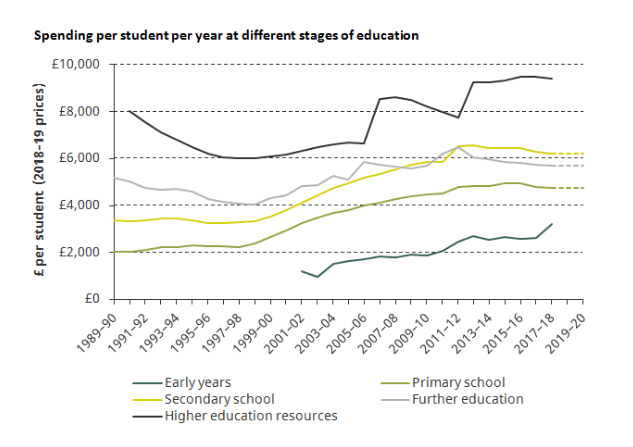
Luke Sibieta, co-author of the report and Research Fellow at IFS, said: “Over the last 30 years, there have been some remarkable changes in the pattern of education spending. Spending on early education has gone from almost nothing to £3 billion since the early 1990s. Spending per student in higher education has risen by nearly 60% since 1997. Spending per school pupil rose by more than 50% over the 2000s, though it has fallen by 8% since 2010 once you include cuts to local authority spend and school sixth forms. In this context, the almost complete lack of growth in spending on further education is all the more remarkable.”

Christine Farquharson, co-author of the report and Research Economist at IFS, said: “Recent changes to funding formulas in early years, schools and the further education system introduce a more transparent way of allocating resources between institutions and around the country. However, the next big challenge across all these stages is to work out how to design systems that encourage childcare settings, schools, colleges and universities to deliver high-quality education.”

Tim Gardam, Chief Executive of the Nuffield Foundation, said: “The fall in further education spending is clear and worrying. The IFS analysis questions the capacity of the system to successfully deliver the reforms currently underway without additional funding. More fundamentally, government should look hard at these analyses of the myriad ways in which public expenditure flows into the different stages of education from the early years of life into adulthood. Neglect in investment in one educational stage has knock-on effects for others, from the point of view of the individual student and the education system as a whole.”


Related


Explore our projects

A portrait of a teenager wearing casual clothing on an overcast summer day in Whitley Bay, Northeastern England. They are standing and looking concerned as they use their smartphone.
In progress

Welfare | 2026 - 2028

The digital lives of care-experienced children

View project
A simple wall sign outside the British Treasury building at 1 Horse Guards Road, just off Whitehall, London.
In progress

Welfare | 2026 - 2030

IFS Green Budget 2026 – 2029

View project
Over-the-shoulder shot of a female secondary school teacher having a one-to-one conversation with a male teenage student. They are both sitting down and she is maintaining eye contact as she is talking. The teacher is smiling and sharing a positive interaction with the student.
In progress

Education | 2026 - 2028

The impacts of Relational and Restorative Practice in school

View project
Young girl smiling and reading book on green sofa
In progress

Education | 2026 - 2028

Love to Read Phase 2: A large-scale evaluation

View project
In progress

Education | 2026 - 2027

The effects of permanent school closures on pupils’ outcomes

View project
Young well dressed businesswoman working on a computer at the office

Welfare | 2026 - 2029

Pain-at-Work Toolkit for employees with chronic pain (definitive trial) 

View project
In progress

Education | 2026 - 2028

The long-term impact of student loans in further education

View project
Young woman using a digital printing machine on an apprenticeship
In progress

Education | 2026 - 2027

Apprenticeship Pathways

View project

Welfare | 2026 - 2028

Examining gender pension gaps: trajectories over time in the UK

View project
Early years professionals playing with children
In progress

Education | 2026 - 2028

Noise in early years settings for children from under-privileged backgrounds

View project
Female Student Standing Outside College Building
In progress

Education | 2026 - 2027

How do students with SEND fare in the transition to post-16 education?

View project
Parents with baby
In progress

Education | 2026 - 2028

Your Baby and You: Developing the home learning environment for babies

View project
A simple wall sign outside the British Treasury building at 1 Horse Guards Road, just off Whitehall, London.
In progress

Welfare | 2026 - 2030

IFS Green Budget 2026 – 2029

View project
A portrait of a teenager wearing casual clothing on an overcast summer day in Whitley Bay, Northeastern England. They are standing and looking concerned as they use their smartphone.
In progress

Welfare | 2026 - 2028

The digital lives of care-experienced children

View project
Young well dressed businesswoman working on a computer at the office

Welfare | 2026 - 2029

Pain-at-Work Toolkit for employees with chronic pain (definitive trial) 

View project
In progress

Education | 2026 - 2027

The effects of permanent school closures on pupils’ outcomes

View project
Female Student Standing Outside College Building
In progress

Education | 2026 - 2027

How do students with SEND fare in the transition to post-16 education?

View project
Young woman using a digital printing machine on an apprenticeship
In progress

Education | 2026 - 2027

Apprenticeship Pathways

View project
Young girl smiling and reading book on green sofa
In progress

Education | 2026 - 2028

Love to Read Phase 2: A large-scale evaluation

View project
Pioneering study reveals teaching techniques which boost exam performance: a teacher sits on a desk among her secondary school pupils, all looking at the board
In progress

Education | 2026 - 2027

A study of multi-grade teaching in English primary schools

View project
Over-the-shoulder shot of a female secondary school teacher having a one-to-one conversation with a male teenage student. They are both sitting down and she is maintaining eye contact as she is talking. The teacher is smiling and sharing a positive interaction with the student.
In progress

Education | 2026 - 2028

The impacts of Relational and Restorative Practice in school

View project
Parents with baby
In progress

Education | 2026 - 2028

Your Baby and You: Developing the home learning environment for babies

View project
In progress

Education | 2026 - 2028

The long-term impact of student loans in further education

View project

Welfare | 2025 - 2026

2026 Scottish Parliament and Senedd election analysis

View project
A simple wall sign outside the British Treasury building at 1 Horse Guards Road, just off Whitehall, London.
In progress

Welfare | 2026 - 2030

IFS Green Budget 2026 – 2029

View project
A portrait of a teenager wearing casual clothing on an overcast summer day in Whitley Bay, Northeastern England. They are standing and looking concerned as they use their smartphone.
In progress

Welfare | 2026 - 2028

The digital lives of care-experienced children

View project
In progress

Education | 2026 - 2027

The effects of permanent school closures on pupils’ outcomes

View project
Female Student Standing Outside College Building
In progress

Education | 2026 - 2027

How do students with SEND fare in the transition to post-16 education?

View project
Young woman using a digital printing machine on an apprenticeship
In progress

Education | 2026 - 2027

Apprenticeship Pathways

View project
Young girl smiling and reading book on green sofa
In progress

Education | 2026 - 2028

Love to Read Phase 2: A large-scale evaluation

View project
Pioneering study reveals teaching techniques which boost exam performance: a teacher sits on a desk among her secondary school pupils, all looking at the board
In progress

Education | 2026 - 2027

A study of multi-grade teaching in English primary schools

View project
Over-the-shoulder shot of a female secondary school teacher having a one-to-one conversation with a male teenage student. They are both sitting down and she is maintaining eye contact as she is talking. The teacher is smiling and sharing a positive interaction with the student.
In progress

Education | 2026 - 2028

The impacts of Relational and Restorative Practice in school

View project
Parents with baby
In progress

Education | 2026 - 2028

Your Baby and You: Developing the home learning environment for babies

View project
In progress

Education | 2026 - 2028

The long-term impact of student loans in further education

View project
In progress

Education | 2026 - 2027

Trialling an assessment protocol for LLM-powered careers advice 

View project
Teaching assistant plays with little boy at nursery
In progress

Education | 2025 - 2026

Room to Grow: School-based Nursery Places and the Disadvantage Gap

View project
Reported

Education | 2025 - 2025

Exploring Multi Academy Trust approaches to Artificial Intelligence

View project
Pre-school students sitting in an art classroom being taught by a teacher. The classroom is colourful and the children are sat at a big table.
Reported

Education | 2024 - 2026

A comparative analysis of EY workforce policy in the four UK nations

View project
Black woman typing on laptop in living room
Reported

Welfare | 2024 - 2025

Enhancing, localising and democratising tax-benefit policy analysis

View project
Young girl using an iPad at home
Reported

Education | 2024 - 2024

Early years digital media literacy review

View project
Secondary school music teacher smiles at students working together at a keyboard.
Reported

Education | 2024 - 2026

Teacher recruitment & retention challenges in England

View project
A middle-aged man sat at home is looking at this phone while sorting pension paperwork.
Reported

Welfare | 2023 - 2025

Collective defined contribution pensions with investment choice

View project
Sixth form student smiling in a classroom while a teacher helps a classmate in the row behind him
Reported

Education | 2023 - 2025

The Extended Project Qualification: An Opportunity for All?

View project
Teenage sixth form students walking into college
Reported

Education | 2023 - 2025

Revisiting the raising of the participation age to 18 in England

View project
Two little boys and a little girl, all wearing primary school uniform, work together to solve a puzzle in their classroom.
Reported

Education | 2023 - 2025

What has ‘Free School Meals’ measured and what are the implications?

View project
Elderly man drinking tea at home with professional carer
Reported

Welfare | 2023 - 2024

Evidencing the outsourcing of social care provision in England

View project
Early years professionals playing with children
Reported

Education | 2022 - 2024

Understanding the take-up of early education entitlements

View project
Older woman using a tablet to make a video call
Reported

Welfare | 2023 - 2025

Remote osteoarthritis peer-mentorship for socioeconomically underserved people

View project
Search projects

We improve people’s lives by funding research that informs social policy, primarily in Education, Welfare and Justice. We also fund student programmes that give young people skills and confidence in science and research.

We offer our grant-holders the freedom to frame questions and enable new thinking. Our research must stand up to rigorous academic scrutiny, but we understand that to be successful in effecting change, it also needs to be relevant to people’s experience.

Profile