Did Labour's social policy programme work?

By Nuffield Foundation

Labour’s increased social spending delivered major improvements to services and social outcomes but wider inequalities persisted, according to a new report from the London School of Economics and Political Science (LSE).

The report, Labour’s Social Policy Record: Policy, Spending and Outcomes 1997-2010, assesses Labour’s record on social policy, including health, education, early years, neighbourhood renewal, benefits and pensions. It is a comprehensive analysis of Labour’s social policy record and the first phase in the Social Policy in a Cold Climate series of papers looking at the effect of political and economic change on social policy, poverty and equality.

The next phase will look specifically at the longer term effects of the financial crash and include up-to-date data on social policy under the Coalition government. This will be published in 2015.

The report found that where Labour targeted investment, outcomes improved. Increases in spending facilitated a reduction in rates of child and pensioner poverty, shorter hospital waiting times, improved teacher-pupil ratios and improvements in neighbourhood facilities. But some issues which were not targeted saw little progress. Poverty for working age people without children rose and there was no real change in overall levels of income inequality, while wage inequalities grew at the top.
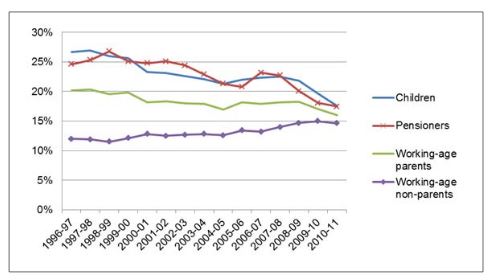
Poverty rates of different groups 1996/7 to 2010/11

The report shows:

  • Public spending went up by 60 per cent and from 39.5 to 47.4 per cent of GDP; but until the crisis hit after 2008, spending levels were unexceptional by historic UK and international standards, and national debt levels were lower than when Labour took office.
  • Most of the extra spending went mainly on improving services. For example there were new hospitals, schools, equipment and ICT, 48,000 extra FTE teachers, 3500 new children’s centres, and more doctors and nurses. Access and quality in public services improved – for example 90 per cent of social housing was brought up to a decent standard. The “gap” in the infant mortality rate between routine/manual groups and the whole population had dropped by 10 per cent in 2008-10.
  • Other outcomes showed little progress. For example, in health, there were increases in the life expectancy gap between the areas with the worst health and deprivation and the England average. Obesity continued to increase. At GCSE, the socio-economic gap closed only very slightly at the level of five GCSEs including English and maths. The gap in educational outcomes between looked-after children and their peers widened on some measures.

Labour’s Social Policy Record, is one of three reports published today by LSE’s Centre for Analysis of Social Exclusion (CASE) as part of the Social Policy in a Cold Climate (SPCC) programme, which is funded by the Joseph Rowntree Foundation, the Nuffield Foundation, and the Trust for London.

Coordinating report author, Professor Ruth Lupton of the University of Manchester and CASE said:

“There is a myth that Labour spent a lot and achieved nothing. The evidence shows that outcomes improved and gaps narrowed on virtually all the socio-economic indicators that were targeted. Labour left the Coalition with a legacy of more equal outcomes on many measures, less poverty and expanded public services. However, their reliance on the labour market to improve the situation for working age people with no children did not pay off – some outcomes for this group got worse.”

CASE Director Professor John Hills, said:

“In a very different economic climate, Labour set out an agenda to raise outcomes overall, narrow socio-economic gaps and modernise public services. Many services were improved, and it achieved a striking narrowing of inequalities between different age groups and across the life cycle. Nevertheless, when Labour left power there had been no real change in wider income inequalities and parts of its vision remained unrealised.”

Also published today as part of the same programme:

Winners and Losers in the Crisis: The Changing Anatomy of Economic Inequality in the UK 2007 – 2010

This updates the 2010 report of the National Equality Panel, and maps out who gained and who lost in the first three years of the recession from 2007 to 2010.

Commenting on the paper Professor Hills said: “Despite being better qualified than previous generations, people in their twenties were worst hit by the financial crisis in terms of unemployment, pay and incomes.”

The report shows that among those in their early 20s:

  • The proportion in full-time employment fell by nine percentage points for men and seven points for women.
  • Hourly wages fell by more than five per cent for men and women
  • Weekly full-time earnings fell six per cent for both men and women
  • Net income fell by 11 per cent before housing costs and 17 per cent after housing costs.

A third report in the programme is also published today:

Prosperity, Poverty and Inequality in London 2000/01 to 2010/11

This report provides a new analysis of changes in poverty and inequality in London during the 2000s, with a particular focus on the impact of the recession, and on changes in London’s geography of poverty.

Full-time employment fell by less across London than elsewhere in the country, and there was a smaller rise in unemployment.

But while London coped well with some economic pressures, inequalities in earnings and incomes increased between 2006/8 and 2010. Those living on the lowest incomes were hit hardest, seeing incomes after housing costs fall by 24 per cent in real terms compared with 3.5 per cent nationally.

Commenting on this report, Professor Lupton said: “London’s economy and labour market were more resilient to the recession than other regions, although there was a rise in people working part-time. However, it remains a problem that London’s economic success does not seem to translate into lower poverty or reduced inequality overall.”

Full reports and summaries available on the CASE website: 

  • Labour’s Social Policy Record: Policy, Spending and Outcomes 1997-2010
  • Labour’s Record on Health
  • Labour’s Record on Cash Transfers, Poverty, Inequality and the Lifecycle
  • Labour’s Record on Education
  • Labour’s Record on Neighbourhood Renewal in England
  • Labour’s Record on the Under-fives
  • Winners and Losers in the Crisis: The Changing Anatomy of Economic Inequality in the UK 2007 – 2010
  • Prosperity, Poverty and Inequality in London 2000/01 to 2010/11

Explore our projects

A portrait of a teenager wearing casual clothing on an overcast summer day in Whitley Bay, Northeastern England. They are standing and looking concerned as they use their smartphone.
In progress

Welfare | 2026 - 2028

The digital lives of care-experienced children

View project
A simple wall sign outside the British Treasury building at 1 Horse Guards Road, just off Whitehall, London.
In progress

Welfare | 2026 - 2030

IFS Green Budget 2026 – 2029

View project
In progress

Education | 2026 - 2028

The long-term impact of student loans in further education

View project
Young well dressed businesswoman working on a computer at the office

Welfare | 2026 - 2029

Pain-at-Work Toolkit for employees with chronic pain (definitive trial) 

View project

Welfare | 2026 - 2028

Examining gender pension gaps: trajectories over time in the UK

View project
Parents with baby
In progress

Education | 2026 - 2028

Your Baby and You: Developing the home learning environment for babies

View project
Houses along a street in the UK

Welfare | 2026 - 2028

Towards housing affordability: local supply drivers and optimal policy

View project
In progress

Racial Diversity UK | Welfare | 2026 - 2027

Racial equality since devolution: Divergences, outcomes and frontiers

View project
voters entering polling station to vote in election

Welfare | 2025 - 2026

Tax, benefits and public spending in the 2026 devolved elections

View project

Welfare | 2025 - 2026

2026 Scottish Parliament and Senedd election analysis

View project
A shot of a grandfather sitting in a tractor with his young granddaughter, he is at his farm in North East, England. The grandfather and the girl's mother are teaching her about the farm.
In progress

Welfare | 2025 - 2028

Arthritis and farmers in England: Impacts, adaptations and prevention

View project
row of houses
In progress

Welfare | 2025 - 2028

Musculoskeletal conditions in underserved communities

View project
A simple wall sign outside the British Treasury building at 1 Horse Guards Road, just off Whitehall, London.
In progress

Welfare | 2026 - 2030

IFS Green Budget 2026 – 2029

View project
A portrait of a teenager wearing casual clothing on an overcast summer day in Whitley Bay, Northeastern England. They are standing and looking concerned as they use their smartphone.
In progress

Welfare | 2026 - 2028

The digital lives of care-experienced children

View project
Young well dressed businesswoman working on a computer at the office

Welfare | 2026 - 2029

Pain-at-Work Toolkit for employees with chronic pain (definitive trial) 

View project
Parents with baby
In progress

Education | 2026 - 2028

Your Baby and You: Developing the home learning environment for babies

View project
In progress

Education | 2026 - 2028

The long-term impact of student loans in further education

View project

Welfare | 2025 - 2026

2026 Scottish Parliament and Senedd election analysis

View project
Houses along a street in the UK

Welfare | 2026 - 2028

Towards housing affordability: local supply drivers and optimal policy

View project

Welfare | 2026 - 2028

Examining gender pension gaps: trajectories over time in the UK

View project
voters entering polling station to vote in election

Welfare | 2025 - 2026

Tax, benefits and public spending in the 2026 devolved elections

View project

Welfare | 2025 - 2028

Actionable insights to tackle UK dietary inequalities

View project
A mid-level street view of an older brick social housing block. To the left is a large green tree.

Welfare | 2025 - 2026

Navigating social housing tenancies: Language and cultural barriers

View project
A heavily pregnant mother working at home on her laptop while talking to her kids as they stand near her.

Welfare | 2025 - 2028

Effective hybrid work: Childcare, work-life balance and well-being

View project
A simple wall sign outside the British Treasury building at 1 Horse Guards Road, just off Whitehall, London.
In progress

Welfare | 2026 - 2030

IFS Green Budget 2026 – 2029

View project
A portrait of a teenager wearing casual clothing on an overcast summer day in Whitley Bay, Northeastern England. They are standing and looking concerned as they use their smartphone.
In progress

Welfare | 2026 - 2028

The digital lives of care-experienced children

View project
Parents with baby
In progress

Education | 2026 - 2028

Your Baby and You: Developing the home learning environment for babies

View project
In progress

Education | 2026 - 2028

The long-term impact of student loans in further education

View project
Kid playing with wood toys at pre school classroom.
In progress

Education | 2025 - 2027

What price is free? The price effects of England’s childcare reforms

View project
In progress

Racial Diversity UK | Welfare | 2026 - 2027

Racial equality since devolution: Divergences, outcomes and frontiers

View project
In progress

Racial Diversity UK | Welfare | 2025 - 2028

Decline to renewal: Race, deindustrialisation and working lives

View project
In progress

Racial Diversity UK | Welfare | 2025 - 2028

Better mixing: Supporting Scotland’s diverse future

View project
In progress

Racial Diversity UK | Welfare | 2025 - 2028

Voices for equity: Moving from evidence to action

View project
Two mothers cuddle their daughter on the sofa with their dog: Welfare access, assets and debts of LGBT+ people in the UK
In progress

Welfare | 2025 - 2027

Understanding fertility intentions in 21st century Britain

View project
In progress

Welfare | 2025 - 2027

Musculoskeletal conditions, employment retention and job quality

View project
lady looking out of the bus window
In progress

Welfare | 2025 - 2028

Economic inactivity, arthritis & depression: who, why & how to respond

View project
Black woman typing on laptop in living room
Reported

Welfare | 2024 - 2025

Enhancing, localising and democratising tax-benefit policy analysis

View project
A middle-aged man sat at home is looking at this phone while sorting pension paperwork.
Reported

Welfare | 2023 - 2025

Collective defined contribution pensions with investment choice

View project
Two little boys and a little girl, all wearing primary school uniform, work together to solve a puzzle in their classroom.
Reported

Education | 2023 - 2025

What has ‘Free School Meals’ measured and what are the implications?

View project
Elderly man drinking tea at home with professional carer
Reported

Welfare | 2023 - 2024

Evidencing the outsourcing of social care provision in England

View project
Older woman using a tablet to make a video call
Reported

Welfare | 2023 - 2025

Remote osteoarthritis peer-mentorship for socioeconomically underserved people

View project
Older man working from home on a video call
Reported

Welfare | 2022 - 2024

The impact of pension auto-enrolment and COVID-19 on saving behaviours

View project
A man working as a delivery driver sits in the driver's seat, checking his list on a tablet
Reported

Welfare | 2022 - 2023

Redesigning labour market policies for the future of work

View project
A group of women walk in a park with their children in pushchairs
Reported

Welfare | 2022 - 2024

Nature-based integration: connecting communities with/in nature

View project
Reported

Education | Welfare | 2022 - 2024

Understanding school attendance, education and labour market outcomes

View project
Two women talk outside a cafe
Reported

Welfare | 2022 - 2023

Housing 21: exploring a more inclusive model of cohousing

View project
A woman helping a little girl get ready for school
Reported

Justice | Welfare | 2022 - 2024

Race, religion and representation among care-experienced children

View project
Grandparents having fun outdoors with their granddaughter, who is eating an apple and laughing: Understanding family and community vulnerabilities in transition to net zero
Reported

Welfare | 2021 - 2023

Understanding family and community vulnerabilities in transition to net zero

View project
Search projects

We improve people’s lives by funding research that informs social policy, primarily in Education, Welfare and Justice. We also fund student programmes that give young people skills and confidence in science and research.

We offer our grant-holders the freedom to frame questions and enable new thinking. Our research must stand up to rigorous academic scrutiny, but we understand that to be successful in effecting change, it also needs to be relevant to people’s experience.

Profile