
75th Anniversary Lecture by Lady Hale

By Nuffield Foundation

We marked our 75th anniversary with a lecture delivered by former Nuffield Foundation Trustee, The Rt Hon the Baroness Hale of Richmond, President of the Supreme Court.

The lecture, given on Monday 14 May, was the highlight of a two-day international research symposium convened in partnership with The Legal Education Foundation and UCL Faculty of Laws to examine and debate how we can harness the power of empirical research to deliver a justice system that serves all citizens.
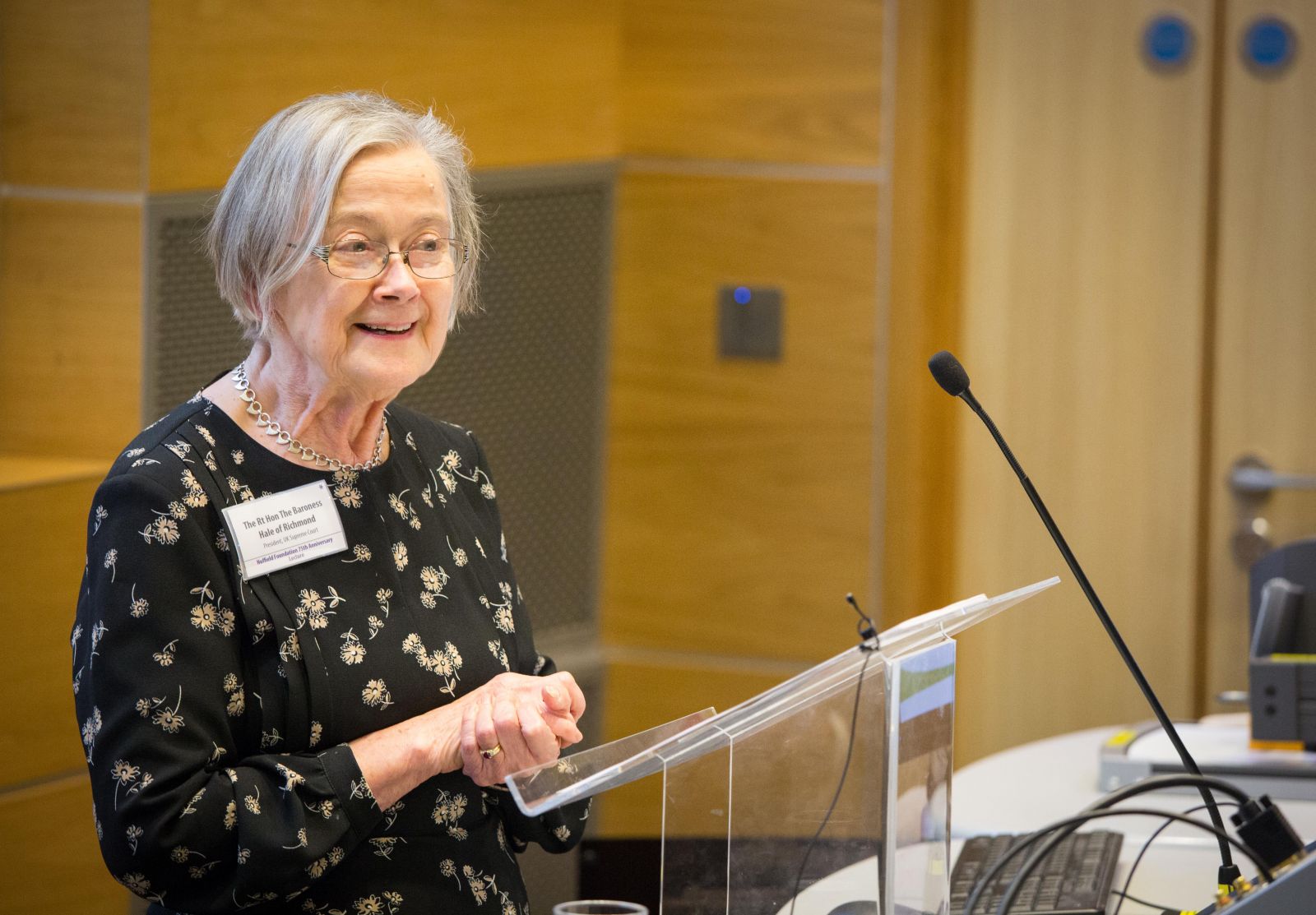
In her well-received lecture, entitled Challenges in the Justice System and the Contribution of Empirical Research, Lady Hale reflected on developments in the justice system over the past 40 years and the Nuffield Foundation’s role in facilitating evidence-based changes in the justice system, stating:

The great benefit of an organisation like Nuffield is that it can look at the challenges from the point of view of the people using or affected by the justice-system – the people for whom it is designed rather than the people doing the designing.

Lady Hale’s lecture explained why empirical research – of the kind funded by the Nuffield Foundation – can help meet the challenges of the justice system, namely:

  • helping us make better decisions in individual cases;
  • helping us to devise better procedures and practices for handling cases generally; and
  • helping us to decide how the law might be improved.

In her lecture, Lady Hale artfully drew together themes from our justice portfolio to give an overview of the Foundation’s current justice work and the impact this could have on the justice system. The lecture touched on the empirical research funded by the Foundation to help meet the challenges in the justice system, including: care proceedings, transparency in family courts, no fault divorce and the Family Justice Observatory.

From 1987 until 2002 Lady Hale was a Trustee of the Nuffield Foundation, an experience she cites as “one of the most rewarding things I ever done”. During that time she stimulated and presided over the Foundation’s special interest in the reform of the law, the legal system and legal processes, particularly in the areas of child protection and the family. The Foundation’s influence in law goes back a long way, for example it funded the first family conciliation service in 1978. But it was under Lady Hale’s expert guidance that the Foundation’s influence in this area really grew, in the late 1980s, grant-making in law averaged less than £80,000 a year, but by 2001, this figure had exceeded half a million. Indeed, her influence remains evident in our current funding priorities in justice, which focus on family and youth justice, good early decision-making, and participation and rights.

By Nuffield Foundation

Explore our projects

Directional signs to the courts in Norwich on the brick wall of a house
In progress

Justice | 2026 - 2027

Exploring the intersections between the criminal and civil courts

View project
New

Justice | 2026 - 2026

Mapping evidence on justice wellbeing impacts after child sexual abuse

View project
Teenage boy looking out of window
New

Justice | 2026 - 2028

Permanently Progressing Phase 3: Adolescence and early adulthood

View project
In progress

Justice | 2026 - 2028

Exploring the child arrangements of separated families

View project
IFS Deaton Review of Inequalities
New

Justice | 2026 - 2027

Diverse disabilities: Accessibility and justice in the tribunal

View project
inequalities in child welfare intervention rates
In progress

Justice | 2025 - 2027

Building Resilience: The feasibility of adapting a child-focused intervention for parental separation 

View project
In progress

Justice | 2025 - 2026

Public law litigation in the automated state

View project
In progress

Justice | 2025 - 2026

Understanding and developing user-focused tribunal hearings

View project
In progress

Justice | 2025 - 2027

Developing a mixed funding model for free legal advice

View project
Rear View Of Girl Holding Ropes At Playground. She is wearing a coat and the sky is grey.
In progress

Justice | 2025 - 2027

 ‘The forgotten 10%’: private family law cases involving non-parents

View project
In progress

Justice | 2025 - 2026

Immigrant families in the Family Justice System

View project
Young well dressed businesswoman working on a computer at the office
Reported

Justice | 2024 - 2025

Developing a digital legal knowledge hub for social welfare law

View project
Teenage boy looking out of window
New

Justice | 2026 - 2028

Permanently Progressing Phase 3: Adolescence and early adulthood

View project
New

Justice | 2026 - 2026

Mapping evidence on justice wellbeing impacts after child sexual abuse

View project
IFS Deaton Review of Inequalities
New

Justice | 2026 - 2027

Diverse disabilities: Accessibility and justice in the tribunal

View project
Directional signs to the courts in Norwich on the brick wall of a house
In progress

Justice | 2026 - 2027

Exploring the intersections between the criminal and civil courts

View project
inequalities in child welfare intervention rates
In progress

Justice | 2025 - 2027

Building Resilience: The feasibility of adapting a child-focused intervention for parental separation 

View project
In progress

Justice | 2026 - 2028

Exploring the child arrangements of separated families

View project
In progress

Justice | 2025 - 2026

Public law litigation in the automated state

View project
In progress

Justice | 2025 - 2027

Developing a mixed funding model for free legal advice

View project
Young well dressed businesswoman working on a computer at the office
Reported

Justice | 2024 - 2025

Developing a digital legal knowledge hub for social welfare law

View project
In progress

Justice | 2025 - 2026

Understanding and developing user-focused tribunal hearings

View project
Rear View Of Girl Holding Ropes At Playground. She is wearing a coat and the sky is grey.
In progress

Justice | 2025 - 2027

 ‘The forgotten 10%’: private family law cases involving non-parents

View project
In progress

Justice | 2025 - 2026

Immigrant families in the Family Justice System

View project
Teenage boy looking out of window
New

Justice | 2026 - 2028

Permanently Progressing Phase 3: Adolescence and early adulthood

View project
New

Justice | 2026 - 2026

Mapping evidence on justice wellbeing impacts after child sexual abuse

View project
IFS Deaton Review of Inequalities
New

Justice | 2026 - 2027

Diverse disabilities: Accessibility and justice in the tribunal

View project
Directional signs to the courts in Norwich on the brick wall of a house
In progress

Justice | 2026 - 2027

Exploring the intersections between the criminal and civil courts

View project
inequalities in child welfare intervention rates
In progress

Justice | 2025 - 2027

Building Resilience: The feasibility of adapting a child-focused intervention for parental separation 

View project
In progress

Justice | 2026 - 2028

Exploring the child arrangements of separated families

View project
In progress

Justice | 2025 - 2026

Public law litigation in the automated state

View project
In progress

Justice | 2025 - 2027

Developing a mixed funding model for free legal advice

View project
In progress

Justice | 2025 - 2026

Understanding and developing user-focused tribunal hearings

View project
Rear View Of Girl Holding Ropes At Playground. She is wearing a coat and the sky is grey.
In progress

Justice | 2025 - 2027

 ‘The forgotten 10%’: private family law cases involving non-parents

View project
In progress

Justice | 2025 - 2026

Immigrant families in the Family Justice System

View project
In progress

Justice | 2024 - 2026

Understanding the circumstances of children involved in breach proceedings

View project
Young well dressed businesswoman working on a computer at the office
Reported

Justice | 2024 - 2025

Developing a digital legal knowledge hub for social welfare law

View project
Reported

Justice | 2024 - 2025

Immigration detention and the rule of law

View project
Reported

Justice | 2024 - 2025

Crossing boundaries: Co-designing support for vulnerable young people

View project
Reported

Justice | 2019 - 2023

Born into care: best practice guidelines

View project
An older couple using a tablet to make a video call: Understanding local legal needs and supporting early intervention
Reported

Justice | 2022 - 2025

Understanding local legal needs and supporting early intervention

View project
Reported

Justice | 2021 - 2023

Delivering administrative justice after the pandemic

View project
Long-term outcomes for care-experienced parents and children: a father comes into the kitchen carrying a cup of tea. Two children are standing in the kitchen with their mother, who is holding and feeding the baby
Reported

Justice | 2021 - 2026

Long-term outcomes for care-experienced parents and children

View project
Siblings play ball in a playground - Siblings Contact and the Law
Reported

Justice | 2020 - 2021

Guidance to judges on the anonymisation of children judgements

View project
Lawyer taking witness statement from male witness
Reported

Justice | 2019 - 2021

The production of witness statements by lawyers and litigants in person

View project
Reported

Justice | 2020 - 2022

When is a wedding not a marriage? Exploring non-legally binding ceremonies

View project
Reported

Justice | 2019 - 2022

The Edinburgh Study: causes and impacts of criminal justice pathways

View project
Reported

Justice | Welfare | 2015 - 2018

Bridging the Evidence Gap in Family Proceedings

View project
Search projects

We improve people’s lives by funding research that informs social policy, primarily in Education, Welfare and Justice. We also fund student programmes that give young people skills and confidence in science and research.

We offer our grant-holders the freedom to frame questions and enable new thinking. Our research must stand up to rigorous academic scrutiny, but we understand that to be successful in effecting change, it also needs to be relevant to people’s experience.

Profile