-
Dr Hannah King

-
By Nuffield Foundation
-
Listen to this page
-
Education to work
-
 Download PDF

Current media debates lead us to believe that today’s generation of young people have vastly different expectations of work to older workers. But how do Gen Z define ‘good jobs’? Are their perceptions of work unrealistic and what does this mean for employers? Surprisingly little evidence supports this. Yet understanding young people’s experiences of and ambitions for good jobs is an important step in aligning employers and young people so that they can access good work.
In this article we share new research from Youth Futures Foundation[1], the What Works Centre for Youth Employment, which explores young people’s views of what makes for good jobs, the challenges they face and what this means for the rest of the workforce.
The Youth Employment Challenge
Since the pandemic, the number of young people not in education, employment or training (NEET), including those who are unemployed and economically inactive, has increased by about 50% to almost 1 million 16-24 years olds today.[2] This differs from the increased NEET levels after the global financial crisis, where unemployment rose but economic inactivity remained stable.
Today, whilst the number of young people continuing in education has increased, long-term sickness is the most common reason for economic inactivity amongst this group. Over half of the increase is due to ill-health with mental health the most common reason.[3] The youth mental health crisis extends well beyond the minority who are economically inactive. Over the last 20 years young people have gone from having the lowest rate of reporting mental health symptoms, like anxiety and depression, compared to the rest of the population, to the highest.[4] This represents a new dimension in the youth employment challenge and one which Youth Futures recently investigated in a groundbreaking study into the causes of young people’s rising mental ill health, which identified employment precarity and financial insecurity as key contributors.[5]
These rises in economic inactivity and unemployment are not reflected in other age groups to such an extent, with young people experiencing the worst decline in labour market outcomes.[6] Compared to the rest of the working age population, they are also disproportionately more likely to experience insecure work[7] – 46% of young people aged 16-19, and 27.9% of young people aged 20-24 are in insecure work and of those, 34.6% of 16–19-year-olds and 12.7% aged 20-24 are in low paid insecure work.[8] Young people (aged 16-24) are also almost six times more likely to be on zero-hour contracts than workers across older age groups.[9] Regardless of educational level, their are now significantly lower than for older workers when they were the same age.[10] They also suffer from unstable employment and career opportunities.[11] Alongside an unfavourable labour market, young people continue to bear the brunt of other structural pressures, which have been intensified and exacerbated by the pandemic, including the housing and cost-of-living crises. They are the first generation in a century to face downward social mobility compared to their parents.
Barriers to securing good work have been exacerbated since the pandemic, including a lack of available jobs locally, declining transport, lack of work experience, lack of contacts, lower wages at entry level and diminishing apprenticeships (40% drop in young people starting apprenticeships since 2017[12]), with young people from disadvantaged backgrounds disproportionately impacted.[13] Marginalised young people experiencing intersecting inequalities fare worse. For example, young people from low socio-economic backgrounds, with low qualifications and special educational needs and disabilities (SEND) are almost three times more likely to be NEET, with a NEET rate 170% higher than the average.[14] Almost half of young people (48%) surveyed by Youth Futures (2024) reported experiencing some form of prejudice or discrimination, yet 79% of those did not formally report it. In the UK, nearly half (46%) of all young people report that they are uncertain about their career options – doubling since 2018.[15] Frustrated at navigating a fragmented system and a perceived cultural bias against vocational routes, young people find the processes in place confusing, not knowing where to go for support.[16]
Good jobs for young people
The aspirations of young people to find good work stand in sharp contrast to familiar depictions of Gen Z as ‘lazy’, ‘workshy’, ‘woke’, ‘snowflakes’. Today’s stereotypes simply continue a long tradition of reproaching young people and intergenerational misunderstanding; they do not reflect the lived realities of young workers.
So, what do this generation of young people want from work? Are their hopes and expectations for good jobs unreasonable? Beyond those organisations who champion the cause (e.g. Youth Employment UK[17], Youth Futures Foundation[18]), there has been little evidence in the UK on what good work looks like for young people specifically.[19] Significant developments across a multi-disciplinary and multi-stakeholder terrain over the last decade have led to broad acceptance of CIPD’s Good Work Index[20] following the government’s Taylor Review (2017).[21] Yet young people’s voices have been largely absent in debates about and development of definitions, measurements and proposed solutions. for Youth Futures empirically explored what high quality work looks like for young people. This included interviews and focus groups with a diverse range of 100 young people, aged 16-25, across England, alongside participatory research with Youth Futures’ young ambassadors. Drawing on their varied experiences of work and hopes for the future, they identified the key, often intersecting, factors that make up good work. They also reflected on the ways in which these are shaped by, and are responses to, their different characteristics.
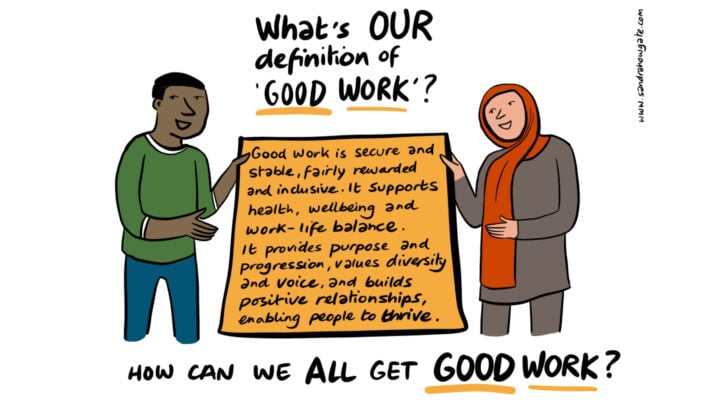
The research found that young people overwhelmingly want the same things that other generations want from work – secure, fairly-paid jobs, which they find meaningful and enable a healthy work-life balance. Based on this, Youth Futures Foundation defines good work for young people as:
“Good work is secure and stable, fairly rewarded and inclusive. It supports health, well-being and work–life balance. It provides purpose and progression, values diversity and voice, and builds positive relationships, enabling people to thrive.”
However, the prioritisation of these vary, reflecting both the stage of the life course and context. For example, whilst flexibility in when you work is seen as particularly important for students and carers, job security (stability in income and the number of hours worked), which enables independent living and covering basic living costs, is paramount for all. Pay is an important factor in good work, but it is rarely a key motivating factor – not a single young person cited a big salary in their description of a good job. Young people understand why older adults may assume they don’t need better wages, as the majority will have some form of parental/family safety net; but this is not the case for all young people, particularly marginalised groups. Pay is thus framed in terms of the minimum needed to survive/live, with an ambition to one day be able to save towards a house and a family but with acknowledgement that for most this is now unrealistic and unachievable. Pay is also about fairness and respect, but young people accept lower starting wages with the expectation of progression (financially and in responsibility) as they become more experienced.
Maintaining a good work-life balance is imperative for young people and deeply connected with their health and well-being. Balancing work with other life commitments is often difficult but essential. Young people described how being constantly ‘on’, anxiously wondering when you might be offered a shift and then not feeling able to turn it down (regardless of other commitments and jobs) because of the risk of being ‘ghosted’ by your employer, is crippling for their mental health. Work is seen as more than just a means to earn money – it is about personal growth, purpose, identity and contributing meaningfully to society. However, this can and should apply to any job, including low-skilled repetitive roles, which they may not see as future careers. In any work, young people want to have a sense of pride and motivation to do the job well; but this is shaped by other factors including management, opportunities for progression, environment and pay (minimum wage).
The culture of the workplace and the relationships young people experience are very important to their conception of good work. Authenticity and having a sense of belonging, social connection, feeling valued and supported to be part of the team, are particularly important for young people starting out on their work journeys. Young people value managers and teams who understand the diverse experiences and needs of young workers and the barriers some may face, creating an inclusive culture that addresses age-related biases and generational differences. Combined with having a voice in the workplace – sharing ideas, expressing concerns and being heard – this creates a supportive and healthy work environment, leading to increased confidence and feeling comfortable, accepted and being able to be oneself.
Young people’s perceptions of good work are shaped by their experiences, expectations and aspirations. Regardless of social class, job aspirations are influenced by parents and peers and grounded in young people’s social realities.[22] [23] Analysis of long-term trends in youth employment demonstrate the changing relationship between education (qualification level) and job quality for young people with precarious work the ‘new normal’ regardless of educational qualifications.[24] [25] Unsurprisingly then, young people do not believe the work available to them is of good quality and faced with the need for an income, prioritising the quality of work becomes a ‘privilege’.[26]
The qualities young people seek in a good job are the same for those at the younger end of the age range in their first part-time employment as they are for those living independently and embarking on careers. However, wider inequalities (such as socio-economic background, housing, health) and individual circumstances shape their prioritisation of the qualities of a good job. For example, the difference in perception of top jobs between school-age young people and young people already in work is telling. BBC’s recent Bitesize Careers Survey[27] of 13-16 year olds featured doctor, engineer, teacher, vet, police officer, lawyer and nurse in the top 10 desired jobs and the NHS the top organisation to work for, with 85% confident they could get their desired job. Conversely, many 16–25-year-olds in Youth Future’s recent research, described NHS and teaching roles as having become ‘bad jobs’ because of the high workload, unreasonable pressures and poor terms and conditions, despite the strength of these jobs’ meaningfulness.
Don’t we all want good jobs? A healthy workforce
Although evidence suggests today’s young people are entering work with more progressive and inclusive values than previous generations, this.[28] A majority (66%) of under-24s want governments to prioritise social progress over economic growth – the opposite of over-50s.[29] They increasingly see work as something that should support, not consume, their lives[30] valuing work-life balance, inclusion and social interaction, thus rejecting what they view as the ‘workaholic’ mindset of previous generations. For example, certain industries and sectors are struggling to attract young people, who view them as less inclusive or progressive. Such values are perhaps a response to their projected futures, which they see as working longer in unstable economies with persistently unequal opportunity structures amidst a climate crisis.
But does this mean they have different views of work to older workers? Like the wider workforce, young people value meaningful work – doing a good job for their employer. In the most recent Skills and Employment Survey,[31] almost 70% of workers of all ages reported their jobs gave them the feeling of a job well done either always or most of the time, and three-quarters consistently had the feeling of doing useful work. An inclusive work environment, where young people feel supported and safe to achieve their best is also key to their health and wellbeing – the very factors the wider workforce cite as fostering meaningfulness.[32] Like the rest of the workforce, they value good managers that consider their needs. Support through clear guidance, recognising their developing skills, training and progression opportunities helps young people feel valued and able to contribute.
Yet these asks and desires would benefit all workers. With almost 3 million people out of work due to long-term health problems, and close to a further 4 million employed with a work-limiting health condition,[33] we “are sliding into an economic inactivity crisis”,[34] with untold costs to employees, employers and the state.[35] Job related ill health has been recognised in multiple government reviews[36] [37] and evidence attests to the elements of jobs that create physical and psycho-social health problems for workers.[38] [39] Thus, improving the quality of and creating healthier jobs is essential for everyone. As Marmot[40] argued a decade ago, this means examining and improving job quality. New generations entering the labour market often challenge the status quo, resulting in workplace improvements for all. As the workforce of the future, listening to young people’s experiences and dreams for inclusive workplaces and stable jobs is a good place to start.
Challenges for employers
Employers are a key part of the jigsaw, enabling young people to transition from education to employment. Whilst negative stereotypes of young people do shape employer views,[41] they too face challenges and frustrations in employing a young workforce. The evidence paints a complex picture demonstrating genuine issues arising from a range of systemic and contemporary factors alongside misunderstanding of young people. For example, CBI’s 2019 report[42] highlights concerns from both perspectives about work readiness, finding that whilst 44% of employers feel that young people leaving school, college or university are not ‘work ready’, 1 in 4 young people themselves do not feel adequately prepared by their education for the world of work. Similarly, CIPD[43] found that over half (52%) of employers do not think that young people are well-prepared, yet for employers who actually had experience of employing young people, this dropped to just one in four (28%). Across industries, employers consistently question young people’s readiness, attitudes and professionalism.[44]
Employers face further challenges in the education-jobs mismatch[45], limited job-specific skills[46] and young people lacking experience (exacerbated by missed opportunities and milestones during the pandemic). Persistent gaps in technical, transferable and employability skills are aggravated by rapid technological advancements and demographic shifts.[47] In response, much needed new reforms are seeking to strengthen the apprenticeships and skills system. Alongside these, the Employment Rights Act brings a mix of opportunities and challenges for employers. The wider context, shaped by an international landscape of economic flux, Brexit, recessions, cost-of-living crisis and rising energy costs, make these challenging times for business.
Despite this context, many employers, of varying sizes and across industries, actively seek to employ young people and support them to thrive in the workplace. The expanding network of benchmarked employers is testament to this. For example, Youth Employment UK’s Good Youth Employment Benchmark/Standards[48] and other employer charters focus on employing those disadvantaged in the labour market, including young people, such as the Social Mobility Foundation’s Employer Index,[49] the Careers & Enterprise Company’s Employer Standards[50] and the Social Recruitment Advocacy Group.[51] However, there remain many more who are not.
Employers have a crucial role to play in helping to resolve the youth employment challenge, but progress is inconsistent. While 65% of employers say experience matters, only 38% offer it, and just 11% to university students.[52] Just 7% of employers have engaged with government (Department for Work and Pensions or Job Centre Plus) employment schemes.[53] Investment in training is declining, dropping by 26% over the last two decades and is now half the EU average.[54] Young people in low-wage sectors, where training is often minimal, are hit hardest, and graduates are three times more likely to receive training than those with no qualifications.[55] [56] Opportunities for progression are equally limited, and progression pathways are often not transparent.[57]
Improving young people’s futures
Having survived major socio-economic changes and political upheaval from the global financial crisis, through austerity and the Covid-19 pandemic, young people’s school-to-work transitions are changing. The scarring effects of recessions and spells of unemployment, insecure work and poor mental health render them at greater risk of future unemployment or poor-quality employment. Whilst age old challenges persist, such as concerns about skills and work-readiness,[58] [59] these are refreshed with a contemporary twist, not least due to rapidly evolving technology, including AI. Young people are experiencing new and distinctive challenges in a changing jobs landscape. In the light of significant employment reform, now is the opportunity for employers to lead and there are key steps they can take. Employers who adapt early will gain in productivity, retention and reputation.
Meeting young people’s priorities for work doesn’t require big budgets – they rely upon the leadership and culture within a workplace that stand to benefit everyone. Encouraging and supporting employers to adopt innovative and sustainable approaches to job creation, investment and growth, benefits all. This requires balancing structural change with sustained and systematic support (including skills, mental health and additional needs) for young people to transition into work (supply side) alongside employer commitment to and investment in young people (demand side). Alongside good jobs, young people need a wider scaffolding of stability through fundamental services and opportunities, including youth services, mental health support and affordable housing. Understanding young people’s lived realities is a key route to bringing employers, policymakers and young workers together to build better understanding, challenge contraction in the youth labour market and achieve good work for all.
There is a strong economic case to be made for addressing the youth employment challenge. Youth Futures[60] research found that by matching the best youth employment and activity rate in the OECD (the Netherlands), the UK could boost its economy by up to £86bn in the long term. But beyond the macro-economics, there is an opportunity to build a fairer, healthier and more resilient workforce. Young people’s voices should be integral to designing the good jobs of the future. Employers, policymakers and young people must seize this moment to align aspirations with action, creating workplaces where every generation can thrive.
References
[1] Youth Futures Foundation (2025) What is good work? https://youthfuturesfoundation.org/about-us/what-is-good-work/
[2] ONS (2026) Young people not in education, employment or training (NEET), UK: https://www.ons.gov.uk/employmentandlabourmarket/peoplenotinwork/unemployment/datasets/
[3] Youth Futures Foundation (2024) Trends in young people not in education, employment or training October – December 2024: https://youthfuturesfoundation.org/wp-content/uploads/2025/05/YF-NEETS-TRENDS-ANALYSIS-3pp-A4-Final.pdf
[4] McCurdy, C. and Murphy, L. (2024) We’ve only just begun Action to improve young people’s mental health, education and employment, Resolution Foundation/The Health Foundation: https://www.resolutionfoundation.org/app/uploads/2024/02/Weve-only-just-begun.pdf
[5] Pierce, M., Bai, Y., Taxiarchi, V., Hugh-Jones, S., Abel, K., Patalay, P. and Demkowicz, O. (2025) Understanding drivers of recent trends in young people’s mental health. Youth Futures Foundation: https://youthfuturesfoundation.org/publication/report-understanding-drivers-of-recent-trends-in-young-peoples-mental-health/
[6] Youth Futures Foundation (2024) Trends in young people not in education, employment or training October – December 2024: https://youthfuturesfoundation.org/wp-content/uploads/2025/05/YF-NEETS-TRENDS-ANALYSIS-3pp-A4-Final.pdf
[7] Gallie, D., A. Felstead, F. Green, and H. Inanc. (2017). “The Hidden Face of Job Insecurity.” Work, Employment and Society 31 (1): 36–53.
[8] Richardson, J. (2023) Precarious Pay and Uncertain Hours – Insecure Work in the UK Labour Market, London: Living Wage Foundation
[9] Martin, A., Williams, G., Atay, A. and Florisson, R (2024) Zero Choices: Swapping zero-hour contracts for secure, flexible working, The Work Foundation: Lancaster University
[10] Dabla-Norris, E., Pizzinelli, C., Rappaport, J. (2019) Job Polarization and the Declining Fortunes of the Young: Evidence from the United Kingdom. IMF Working Paper WP/19/2016
[11] O’Reilly J, Grotti R and Russell H (2019) Are some sectors more ‘youth friendly’ than others? Employment regimes, sectors, and gender disparities in the Great Recession. Human Resource Management Journal 29(3): 490–508
[12] Youth Futures Foundation (2025) Apprenticeships Unwrapped: https://youthfuturesfoundation.org/wp-content/uploads/2026/02/Apprenticeships-Unwrapped_Employer-Resource_Youth-Futures-Foundation_February-2026.pdf
[13] , M., Gifford, J. & Zhou, Y. (2022). Social stratification in meaningful work: Occupational class disparities in the United Kingdom. The British Journal of Sociology, 73(3), 536–553. https://doi.org/10.1111/1468-4446.12941
[14] Impetus (2025) Youth Jobs Gap: Exploring compound disadvantage. Research briefing 10 May 2025: https://impetus-org.files.svdcdn.com/production/assets/publications/Report/Impetus_YouthJobsGap_
[15] OECD (2025) The State of Global Teenage Career Preparation. https://www.educationandemployers.org/mismatch-between-student-aspirations-and-job-market/
[16] Robson, J., Xie, Y., Neagu, M. and Relly, SJ. (2025) From Competition to Coordination: Rethinking Post16 Education and Training in the UK. Industry Case Studies. SKOPE: https://www.nuffieldfoundation.org/wp-content/uploads/2022/10/From-Competition-to-Coordination-Rethinking-Post-16-Education-and-Training-in-the-UK.pdf
[17] Youth Employment UK: https://www.youthemployment.org.uk/
[18] Youth Futures Foundation: https://youthfuturesfoundation.org/
[19] See Nuffield (2026) Youth transitions to good employment: East Birmingham and North Solihull for a forthcoming exception: https://www.nuffieldfoundation.org/project/youth-transitions-to-good-employment-east-birmingham-north-solihull
[20] CIPD (2025) Good Work Index: https://www.cipd.org/uk/knowledge/reports/goodwork/
[21] Taylor, M. (2017) Good work: the Taylor review of modern working practices, London: DBEIS: https://www.gov.uk/government/publications/good-work-the-taylor-review-of-modern-working-practices
[22] McKendrick, J., G. Scott, and S. Sinclair. 2007. “Dismissing Disaffection: Young People’s Attitudes towards Education, Employment and Articulation on a Disadvantaged Community.” Journal of Youth Studies 10 (2): 139–160. doi:10.1080/13676260601120179
[23] Roberts, S. 2011. “Beyond ‘NEET’ and ‘Tidy’ Pathways: Considering the ‘Missing Middle’ of Youth Transition Studies.” Journal of Youth Studies 14 (1): 21–39. doi:10.1080/13676261.2010.489604
[24] Furlong, A., J. Goodwin, H. O’Connor, S. Hall, K. Lowden, and R. Plugor. 2017. Young People in the Labour Market. Milton Keynes: Routledge
[25] Bessant, J., R. Farthing, and R. Watts. 2017. The Precarious Generation: A Political Economy of Young People. London: Routledge
[26] Orlando, C. (2021) Not Just Any Job, Good Jobs, IES: Brighton, page 7.
[27] BBC Bitesize (2025) Revealed: New entry in top 10 jobs teenagers want: https://www.bbc.co.uk/bitesize/articles/zrfknk7
[28] Addario, G. and Wilson, C. (2024) Towards a more liberal Britain. Generational change or different times? National Centre for Social Research: https://natcen.ac.uk/sites/default/files/2024-05/Towards%20a%20more%20liberal%20Britain.pdf
[29] European Youth Forum (2021) Youth Progress Report 2021: https://www.youthforum.org/files/YPI20202120Full20Report.pdf
[30] Youth Employment UK (2024) Youth Voice Census 2024 Report: https://www.youthemployment.org.uk/dev/wp-content/uploads/2024/12/2024-Youth-Voice-Census-Report-1-1.pdf
[31] Zhou, Y., Davies, R., Felstead, A., Gallie, D., Green, F. and Henseke, G. (2024) What Makes Work Meaningful? Findings from the Skills and Employment Survey 2024: https://wiserd.ac.uk/wp-content/uploads/4.-What-Makes-Work-Meaningful.pdf
[32] Ibid.
[33] The Health Foundation (2023) What we know about the UK’s working-age health challenge: https://www.health.org.uk/reports-and-analysis/analysis/what-we-know-about-the-uk-s-working-age-health-challenge
[34] Mayfield, C. (2025) Keep Britain Working: Final Report: https://www.gov.uk/government/publications/keep-britain-working-review-final-report/keep-britain-working-final-report
[35] Balogh, R., Dix, G., Harris, J., Toro, C. and Warhurst, C. (2025) The case for creating healthy jobs: A review of the evidence. ReWAGE Evidence Paper. https://warwick.ac.uk/fac/soc/ier/rewage/publications
[36] Marmot, M., Allen, J., Boyce, T., Goldblatt, P. & Morrison, J. (2020). Health Equity in England: The Marmot Review 10 years on, Institute of Healthy Equity. UCL
[37] Taylor, M. (2017) Good work: the Taylor review of modern working practices, London: DBEIS: https://www.gov.uk/government/publications/good-work-the-taylor-review-of-modern-working-practices
[38] Balogh, R., Dix, G., Harris, J., Toro, C. and Warhurst, C. (2025) The case for creating healthy jobs: A review of the evidence. ReWAGE Evidence Paper. https://warwick.ac.uk/fac/soc/ier/rewage/publications
[39] Institute for the Future of Work (2025) The Pissarides Review into the Future of Work and Wellbeing: https://pissaridesreview.ifow.org/
[40] Marmot, M. (2016) The Health Gap: The Challenge of an Unequal World. London: Bloomsbury.
[41] Brant K and Castro L (2019) You can’t ignore millennials: needed changes and a new way forward in entitlement research. Human Resource Management Journal 29: 527–538.
[42] CBI (2019) Getting Young People Work Ready – Our vision for how education should prepare young people for the modern world: https://www.cbi.org.uk/articles/getting-young-people-work-ready/
[43] CIPD (2024) Changing Face of the Youth Labour Market: https://www.cipd.org/globalassets/media/knowledge/knowledge-hub/reports/2024-pdfs/8735-changing-face-of-the-youth-labour-market-web.pdf
[44] Robson, J., Xie, Y., Neagu, M. and Relly, SJ. (2025) From Competition to Coordination: Rethinking Post16 Education and Training in the UK. Industry Case Studies. SKOPE: https://www.nuffieldfoundation.org/wp-content/uploads/2022/10/From-Competition-to-Coordination-Rethinking-Post-16-Education-and-Training-in-the-UK.pdf
[45] Okay-Sommerville, B., Scholarios, D. and Sosu, E. (2019) Young Workers’ Job Satisfaction in Europe. In Furåker, B. & Håkansson, K. (Eds.) Work Orientations. Routledge Studies in Management, Organizations and Society, Chapter 9.
[46] Simms M (2017) Unions and job quality in the UK: extending interest representation within regulation institutions. Work and Occupations 44(1): 47–67
[47] Robson, J., Xie, Y., Neagu, M. and Relly, SJ. (2025) From Competition to Coordination: Rethinking Post16 Education and Training in the UK. Industry Case Studies. SKOPE: https://www.nuffieldfoundation.org/wp-content/uploads/2022/10/From-Competition-to-Coordination-Rethinking-Post-16-Education-and-Training-in-the-UK.pdf
[48] Youth Employment UK, Good Youth Employment Standards: https://www.youthemployment.org.uk/good-youth-employment-standards/
[49] Social Mobility Foundation, Employer Index: https://www.socialmobility.org.uk/employerindex
[50] The Careers & Enterprise Company, Employer Standards: https://www.careersandenterprise.co.uk/employer-standards
[51] Social Recruitment Advocacy Group: https://peopleplus.co.uk/social-recruitment-advocacy-group
[52] Shurr, J., Vivian, D., Kik, G., James, AS., Tweddle, M., Wrathall, H. and Morrice, N. (2017) Employer Perspectives Survey 2016: https://assets.publishing.service.gov.uk/government/uploads/system/uploads/attachment_data/file/622343/EPS_2016_UK_Report.pdf
[53] DWP (2025) DWP Employer Survey 2024: https://www.gov.uk/government/publications
[54] Learning and Work Institute (2024) Employer investment in upskilling and reskilling in a changing economy: https://learningandwork.org.uk/employer-investment-in-upskilling-and-reskilling-in-a-changing-economy/
[55] Learning and Work Institute (2025) Falling short: Understanding further falls in employer training: https://learningandwork.org.uk/falling-short-understanding-further-falls-in-employer-training/
[56] Green, F., Felstead, A. and Gallie, D. (2016) ‘Job quality and inequality: The unequal world of work in the UK, 1986–2012’, IPPR Juncture, 22(4): 329-333.
[57] DWP (2025) DWP Employer Survey 2024: https://www.gov.uk/government/publications/dwp-employer-survey-2024/dwp-employer-survey-2024
[58] Clarke, J. and Willis, P. (1984) Introduction, in Bates, I., Clarke, J., Cohen, P., Finn, D., Moore, R. and Willis, P. Schooling for the dole? The new vocationalism. Basingstoke: Macmillan.
[59] Amble, B. (2005) ‘Employers slam ‘unemployable’ school leavers’ Management Issues, 16th August 2005: https://www.management-issues.com/news/2458/employers-slam-unemployable-school-leavers/
[60] Youth Futures Foundation (2025) Youth Employment Outlook 2025: https://youthfuturesfoundation.org/publication/youth-employment-2025-outlook/