Understanding the identities of young people in care

By Nuffield Foundation

Professor Sariya Cheruvallil-Contractor and her team make the case for a more nuanced approach to care that supports the complex identity needs of minoritised children.

“How might a baby express itself? How would this differ from a teenager’s expression of their identity?”, Dr John Simmonds, Director of Research at CoramBAAF asked attendees at our report launch for Expressions of self.

These “expressions of self” which strengthen family bonds, can be fraught and negotiated – think about a young child’s tantrum as it demands attention in the middle of a busy supermarket or a teenager’s hormone-fuelled rebellion. Consider also how adults react in these moments.

When a child or young person is placed in care, these negotiations can influence whether a child feels at home or out of place. Our research explores how factors such as ethnicity and religion interact with each other and with characteristics like gender, age, sexuality and in this case, their experience of being in care. We’re interested in how these contribute to a child’s identity.

Throughout this research, we relied on children’s and young people’s voices and stories.

Expressions of self report launch | Full event

Centring the narratives of care-experienced children and young people

This research stems from our own positionalities as researchers who are committed to social justice and as parents who want their children to thrive. We are inherently aware of processes of minoritisation that marginalise particular ethnic and religious groups.

When children from these ‘minoritised’ groups enter care, their vulnerabilities are magnified by the dual scrutiny they face; being in care and belonging to minoritised groups. We created a research and practice-focused space where children and young people could share their stories and be heard. These narratives delve into themes of identity, experiences in care, and the fulfilment or lack thereof of their identity-related needs.

Using an intersectional approach, we worked with Black, Asian and mixed-heritage young people aged 14 to 19 to explore their stories. We focused firstly on perceptions of ethnicity and religion and how these change as they overlap with other aspects of identity and, crucially, by being in care. Secondly, we examined their experiences of asking and getting help from social workers, foster carers, adopters and other support systems that provide for their identities while in care.

In-flux identities

We developed a new model – identities in-flux – to inform both theoretical understanding and practical interventions for children in care. This framework urges the adoption of best practices when implementing support plans for young people and children.

Within this model, we consider the nuanced interplay of changing socio-ethnic-religious factors rooted in a child’s biological heritage, their care journey and their own sense of agency in shaping how they want to be seen.

We have since delivered knowledge exchange workshops on this model to frontline social workers. We created the ‘identity see-saw’ as a practical tool to illustrate how identities change and evolve. It recognises the fluid nature of a child or young person’s identity and both the internal and external factors that can influence it including experiences, choices, or contexts.
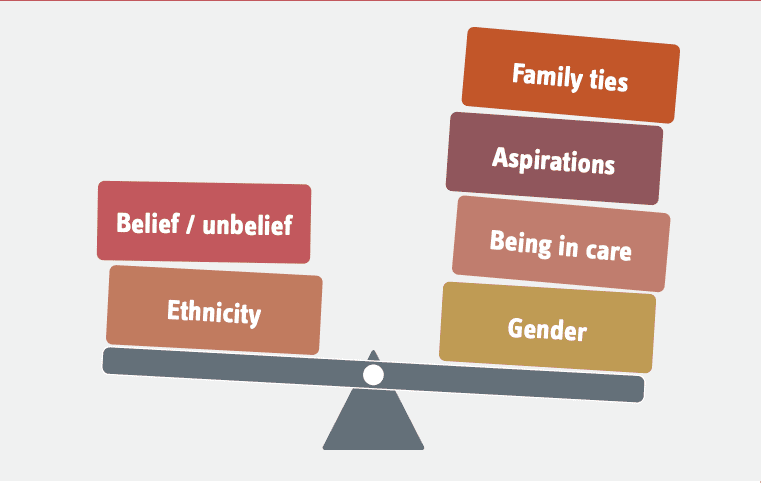
Identity see-saw that shows belief/unbelief and ethnicity on one side and family ties, aspirations, being in care and gender on the other side.
Image source | Expressions of self: Supporting minoritised children’s identity briefing and practice tool

Research that is meaningful for frontline practice

Our research has important implications for frontline practice. For social work professionals, the concept of ‘in-flux identity’ aims to promote self-awareness, inclusivity, empathy, and informed decision-making. It challenges the rigid categorisation and stereotypes that can hinder effective care.

Empathetic listening is crucial for fostering positive identity development among children and young people in care. It involves engaging them in discussions about their identity views and reflecting on how these perceptions impact both themselves and others. We have produced a variety of open-access tools for social workers to use in their everyday practice.

One of our resources – an animation – draws on the stories of the young care-experienced people we spoke to. It considers the implications of our research for transcultural placements and life story work, a social care intervention that helps children in care make sense of their past experiences and understand their personal history.

Anna’s story; creating a space for open dialogue

Anna, a young Black care leaver, shared her experience of being moved between various placements, some of which were matched to her ethnicity, religion, or both. Still, she felt most comfortable and remains in touch with a foster carer who came from a completely different cultural, ethnic, and religious background.

From Anna’s perspective, what made this placement successful was the foster carer’s interest in getting to know her. Early in their relationship, the foster carer sat Anna down and simply asked, “Please tell me about you” leading to a long, meaningful conversation. This open discussion and genuine curiosity from the foster carer helped Anna feel settled.

Taking a more nuanced approach in practice

Our research also sheds light on the importance of re-evaluating how social workers approach life history work. It urges practitioners to reflect on whether life storybooks, assessments and other paperwork accurately reflect the complexities of a child’s layered identity.

Rather than simplifying identities into broad labels, practitioners should focus on understanding the nuanced overlaps and blurred lines between identity categories, all of which are unique to a child’s experience.

Through listening to the voices and stories of these children, our research has provided a more complex framing of the identities of looked-after children and young people from minoritised ethnic and religious heritages.

By equipping social workers to better understand children’s multifaceted identities, we hope to make a difference in the lives of some of society’s most vulnerable constituents.

NOTE: This article was written by some of our grant-holders, but the views expressed are those of the authors and not necessarily the Foundation.

Full List of Open Access Resources

  1. This is an animation that we produced in collaboration with Beluga Animations. In 5 minutes it aims to represent the complexities of children’s identities and ramifications for Social work practice – https://www.youtube.com/watch?v=rr71N8rKYrA
  2. Research Report – https://www.coventry.ac.uk/contentassets/0832b8d761aa49a6adb98cf4112b8cfd/expressions-of-self-report.pdf
  3. Animation produced by young people – https://www.youtube.com/watch?v=OELjMuayIdk
  4. Frontline briefing produced in collaboration with ResearchinPractice – https://www.researchinpractice.org.uk/children/publications/2024/january/expressions-of-self-supporting-minoritised-children-s-identity-frontline-briefing-2024/
  5. Podcast produced in collaboration with ResearchinPractice – https://www.researchinpractice.org.uk/children/content-pages/podcasts/identity-needs-of-minoritised-children-and-young-people-in-care/
  6. Workshop Series (please book a space) produced in collaboration with ResearchinPractice – https://www.researchinpractice.org.uk/children/events-learning/2024/january/understanding-and-supporting-the-identities-of-minoritised-children-in-care/

Read the full report


By Nuffield Foundation

Explore our projects

Directional signs to the courts in Norwich on the brick wall of a house
In progress

Justice | 2026 - 2027

Exploring the intersections between the criminal and civil courts

View project
New

Justice | 2026 - 2027

Access to justice in legal challenges to infrastructure projects

View project
New

Justice | 2026 - 2026

Mapping evidence on justice wellbeing impacts after child sexual abuse

View project
Teenage boy looking out of window
New

Justice | 2026 - 2028

Permanently Progressing Phase 3: Adolescence and early adulthood

View project
In progress

Justice | 2026 - 2028

Exploring the child arrangements of separated families

View project
IFS Deaton Review of Inequalities
In progress

Justice | 2026 - 2027

Diverse disabilities: Accessibility and justice in the tribunal

View project
inequalities in child welfare intervention rates
In progress

Justice | 2025 - 2027

Building Resilience: The feasibility of adapting a child-focused intervention for parental separation 

View project
In progress

Justice | 2025 - 2026

Public law litigation in the automated state

View project
In progress

Justice | 2025 - 2026

Understanding and developing user-focused tribunal hearings

View project
In progress

Justice | 2025 - 2027

Developing a mixed funding model for free legal advice

View project
Rear View Of Girl Holding Ropes At Playground. She is wearing a coat and the sky is grey.
In progress

Justice | 2025 - 2027

 ‘The forgotten 10%’: private family law cases involving non-parents

View project
In progress

Justice | 2025 - 2026

Immigrant families in the Family Justice System

View project
New

Justice | 2026 - 2027

Access to justice in legal challenges to infrastructure projects

View project
Teenage boy looking out of window
New

Justice | 2026 - 2028

Permanently Progressing Phase 3: Adolescence and early adulthood

View project
New

Justice | 2026 - 2026

Mapping evidence on justice wellbeing impacts after child sexual abuse

View project
IFS Deaton Review of Inequalities
In progress

Justice | 2026 - 2027

Diverse disabilities: Accessibility and justice in the tribunal

View project
Directional signs to the courts in Norwich on the brick wall of a house
In progress

Justice | 2026 - 2027

Exploring the intersections between the criminal and civil courts

View project
inequalities in child welfare intervention rates
In progress

Justice | 2025 - 2027

Building Resilience: The feasibility of adapting a child-focused intervention for parental separation 

View project
In progress

Justice | 2026 - 2028

Exploring the child arrangements of separated families

View project
In progress

Justice | 2025 - 2026

Public law litigation in the automated state

View project
In progress

Justice | 2025 - 2027

Developing a mixed funding model for free legal advice

View project
Young well dressed businesswoman working on a computer at the office
Reported

Justice | 2024 - 2025

Developing a digital legal knowledge hub for social welfare law

View project
In progress

Justice | 2025 - 2026

Understanding and developing user-focused tribunal hearings

View project
Rear View Of Girl Holding Ropes At Playground. She is wearing a coat and the sky is grey.
In progress

Justice | 2025 - 2027

 ‘The forgotten 10%’: private family law cases involving non-parents

View project
New

Justice | 2026 - 2027

Access to justice in legal challenges to infrastructure projects

View project
Teenage boy looking out of window
New

Justice | 2026 - 2028

Permanently Progressing Phase 3: Adolescence and early adulthood

View project
New

Justice | 2026 - 2026

Mapping evidence on justice wellbeing impacts after child sexual abuse

View project
IFS Deaton Review of Inequalities
In progress

Justice | 2026 - 2027

Diverse disabilities: Accessibility and justice in the tribunal

View project
Directional signs to the courts in Norwich on the brick wall of a house
In progress

Justice | 2026 - 2027

Exploring the intersections between the criminal and civil courts

View project
inequalities in child welfare intervention rates
In progress

Justice | 2025 - 2027

Building Resilience: The feasibility of adapting a child-focused intervention for parental separation 

View project
In progress

Justice | 2026 - 2028

Exploring the child arrangements of separated families

View project
In progress

Justice | 2025 - 2026

Public law litigation in the automated state

View project
In progress

Justice | 2025 - 2027

Developing a mixed funding model for free legal advice

View project
In progress

Justice | 2025 - 2026

Understanding and developing user-focused tribunal hearings

View project
Rear View Of Girl Holding Ropes At Playground. She is wearing a coat and the sky is grey.
In progress

Justice | 2025 - 2027

 ‘The forgotten 10%’: private family law cases involving non-parents

View project
In progress

Justice | 2025 - 2026

Immigrant families in the Family Justice System

View project
Young well dressed businesswoman working on a computer at the office
Reported

Justice | 2024 - 2025

Developing a digital legal knowledge hub for social welfare law

View project
Reported

Justice | 2024 - 2025

Immigration detention and the rule of law

View project
Reported

Justice | 2024 - 2025

Crossing boundaries: Co-designing support for vulnerable young people

View project
Reported

Justice | 2019 - 2023

Born into care: best practice guidelines

View project
Reported

Justice | 2022 - 2024

Transparency and judicial review: a study of the duty of candour

View project
A teenage boy outdoors
Reported

Justice | 2022 - 2024

Child First: examining children’s collaboration in the Youth Justice System

View project
Two children walk ahead of two adults, one pushing a pram
Reported

Justice | 2022 - 2024

Voluntary care plans for children in Scotland: using Section 25 orders

View project
An older couple using a tablet to make a video call: Understanding local legal needs and supporting early intervention
Reported

Justice | 2022 - 2025

Understanding local legal needs and supporting early intervention

View project
A woman helping a little girl get ready for school
Reported

Justice | Welfare | 2022 - 2024

Race, religion and representation among care-experienced children

View project
A parent or carer holds a small child
Reported

Justice | 2020 - 2023

Discharge of care orders: a national study

View project
A little girl smiles at her father
Reported

Justice | 2021 - 2024

Substituted parenting: what does this mean in the family court?

View project
Mapping the changing face of cross-examination in criminal trials: a witness in court
Reported

Justice | 2020 - 2024

Mapping the changing face of cross-examination in criminal trials

View project
Search projects

We improve people’s lives by funding research that informs social policy, primarily in Education, Welfare and Justice. We also fund student programmes that give young people skills and confidence in science and research.

We offer our grant-holders the freedom to frame questions and enable new thinking. Our research must stand up to rigorous academic scrutiny, but we understand that to be successful in effecting change, it also needs to be relevant to people’s experience.

Profile