










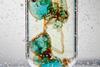
Use this practical or demonstration to provide a visual illustration of an oscillating reaction and redox equilibria
In this experiment, students mix acidified sodium (or potassium) bromate and bromide solutions, before adding propanedioic (malonic) acid, ferroin indicator and a surface-active agent. They then observe the mixture as it exhibits oscillating patterns from red to blue over a period of several minutes.
The experiment provides an illustration of how a series of interconnected redox equilibria and their rates can lead to a repeating cycle of reactions, made visible by the inclusion of a suitable redox indicator.
The reaction can be carried out as a demonstration (especially for open days or chemistry clubs), or as a class exercise. It is an interesting and colourful process, but the reactions involved and the mechanism are complex – see Teaching notes below.
Time required should be about ten minutes.
Equipment
Apparatus
- Eye protection (goggles when preparing Solution A – see note 9 below)
- Beakers, 100 cm3, x4
- Petri dish
- Measuring cylinder, 10 cm3
- Plastic syringes, 1 or 2 cm3, x3
- Dropping pipette
Chemicals
- Sodium bromate(V) (TOXIC, OXIDISING), 5 g (enough for 10 experiments) or potassium bromate(V) (TOXIC, OXIDISING), 5.5 g
- Sodium bromide, 1 g or potassium bromide, 1.2 g
- Concentrated sulfuric acid (CORROSIVE), 2 cm3
- Propanedioic (malonic) acid (HARMFUL), 1 g
- Ferroin indicator solution, 1 cm3
- ‘Photoflo’ solution, 1 drop (see note 8 below)
- Distilled or deionised water, about 100 cm3
Health, safety and technical notes
- Read our standard health and safety guidance.
- Wear eye protection throughout, and goggles when preparing Solution A.
- Sodium bromate(V), NaBrO3(s) or potassium bromate(V), KBrO3(s), (TOXIC, OXIDISING) – see CLEAPSS Hazcard HC080.
- Concentrated sulfuric acid, H2SO4(l), (CORROSIVE) – see CLEAPSS Hazcard HC098a.
- Sodium bromide, NaBr(s), or potassium bromide, KBr(s) – see CLEAPSS Hazcard HC047b.
- Propanedioic (malonic) acid, HOOCCH2 COOH(s), (HARMFUL) – see CLEAPSS Hazcard HC036B.
- Ferroin indicator – see CLEAPSS Hazcard HC032 and CLEAPSS Recipe Book RB000.
- ‘Photoflo’ solution – can be purchased via online retailers, photography shops or many supermarkets. It is a surface-active agent used in photographic developing and printing.
- In advance of the demonstration, prepare the following solutions in small beakers:
- Solution A: dissolve 5 g of sodium bromate(V) (or 5.5 g of potassium bromate(V)) and 2 cm3 of concentrated sulfuric acid in 67 cm3 of distilled or deionised water.
- Solution B: dissolve 1 g of sodium bromide (or 1.2 g of potassium bromide) in 10 cm3 of distilled or deionised water.
- Solution C: dissolve 1 g of propanedioic acid in 10 cm3 of distilled ordeionised water.
Procedure
- Place 6 cm3 of Solution A in a small beaker, using a measuring cylinder.
- Add 0.5 cm3 of Solution B, using a syringe.
- Add 1.0 cm3 of Solution C, using a syringe. A brown colour appears. When this disappears, add 1.0 cm3 of ferroin solution, using a syringe.
- Add 1 drop of ‘Photoflo’ (or equivalent) solution, using a dropping pipette.
- Swirl to mix well and pour enough of the mixture in to the Petri dish to half-fill it. Wait for the oscillations to begin.
Teaching notes
This is a version of the classic Belousov–Zhabotinksy oscillating reaction. Its detailed mechanism is very complicated – see Further information below. Suffice it to say here that bromate and bromide ions first react with propanedioic acid to produce a bromopropanedioate. Bromate also oxidises the iron(II) in the red ferroin indicator to produce a blue iron(III) species. The bromopropanedioate and the blue species then react to form bromide. Bromide inhibits the reaction of the red iron(II) species to form the blue iron(III) species and so a red colour reappears.
Further information
- Further details can be obtained in New Scientist Guide to Chaos, p. 111, N.Hall (Ed), London: Penguin, 1991 or in Chemical Demonstrations – Volume 2, B.Shakhashiri, University of Wisconsin Press, 1986.
- A resource from the Lycée Faidherbe de Lille provides more information about oscillating reactions and chemical waves.
Additional information
This is a resource from the Practical Chemistry project, developed by the Nuffield Foundation and the Royal Society of Chemistry. This collection of over 200 practical activities demonstrates a wide range of chemical concepts and processes. Each activity contains comprehensive information for teachers and technicians, including full technical notes and step-by-step procedures. Practical Chemistry activities accompany Practical Physics and Practical Biology.
© Nuffield Foundation and the Royal Society of Chemistry



No comments yet